The Two Weeks That Will Be (22nd February 2026)

1. The UK
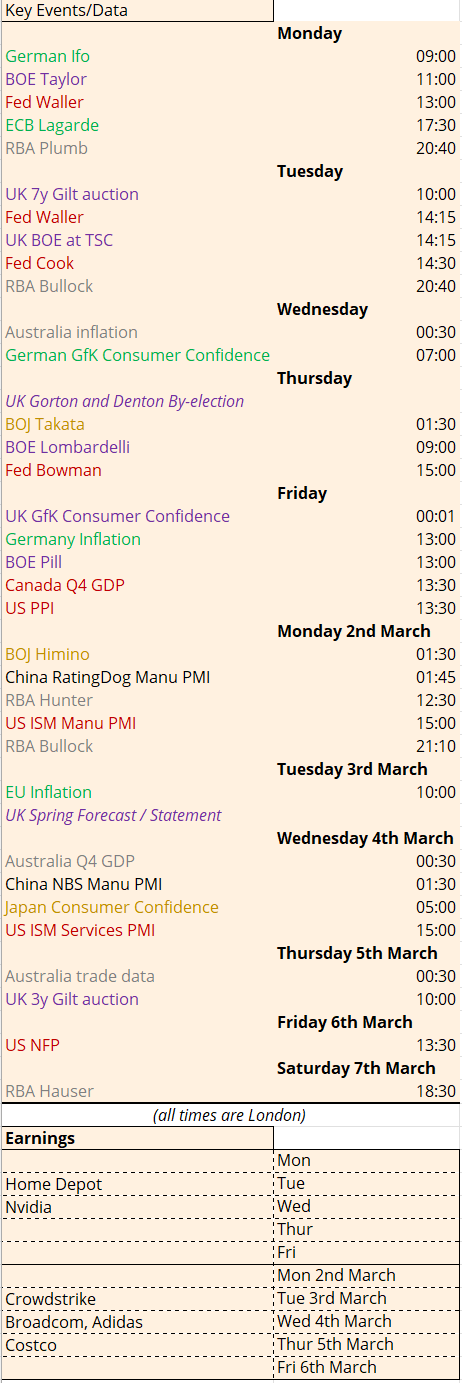
The UK Prime Minister wanted the next couple of weeks to be a non-event. A quick by-election in a Labour heartland, catching upstart parties on the hop, followed by a routine update of economic forecasts by the OBR. Nothing to see here, please move along. Instead he faces the first electoral test of his personal judgement with the Gorton and Denton by-election on Thursday and, in its aftermath, a verdict on his economic plan with the Spring Forecast on Tuesday 3rd March. This would have been a pivotal period even without his premiership hanging by a thread; now it will prove decisive. Just because he has not yet fallen, or been pushed, over the cliff edge, doesn’t mean he’s not still teetering on the brink.
The by-election outcome, which we should know on Friday, will be unusually chaotic. There are three parties in contention, which in itself is a warning sign for the government given it is one of 70 seats that Labour had won with an absolute majority in 2024 (see this substack from Rob Ford, Manchester University politics professor, for more useful stats). The fact Reform is one of the three is astonishing, given the seat would be 413th on their target list in terms of the swing required to take it. Ditto the Greens, who have doubled their national polling since Zack Polanski became leader less than six months ago. This by-election should have been little more than a low-turnout, mid-term, slap in the face for a beleaguered government. Instead all Labour MPs have been instructed to offer their support in the constituency and not a day goes by without another MP posing by the ballooning noticeboard of visiting signatories (the one below courtesy of MP Luke Pollard):

Labour are attempting to win over voters one by one – literally. Small groups of twelve have been invited to private gatherings with the Labour candidate, Andy Burnham and the leader of Manchester City council in an attempt to persuade them to vote Labour. Labour’s Deputy Leader, Lucy Powell, has claimed that they have “extensive data – having now spoken to over a third of eligible voters”. But as the Conservative Party found out to their cost at the last general election, it’s hard to navigate constituencies which you considered to be safe seats. You don’t have much data in places where the votes used to be weighed rather than counted. Speaking to one third leaves two thirds unaccounted for, and precious little time to know which proportion are more representative of the actual voters who will turn out on the day.
Powell’s comment came in a rather irritable response to Polanski as she sought to question the result of a rare constituency poll that put the Greens in first place, Reform second and Labour third. As it happens, we expect that exact outcome. Disillusionment with the government will split into votes for Reform, and those who seek to stop all that Reform stands for. It will not pile back into the government that a) triggered the by-election in the first place after its MP stood down in the wake of an offensive message scandal; b) refused to let the most popular (and locally successful) candidate stand after Starmer blocked Burnham; and c) has conducted fourteen u-turns, jacked up taxes, and promoted people who consort with convicted sex offenders. Labour’s campaign has simply been “Vote Labour to stop Reform”. The data doesn’t even back up that argument given support for the Greens, leaving Powell tweeting confusing infographics like this:

With a week to go, Labour appear to have hit the panic button: invoke Thatcher. Both Andy Burnham and Lucy Powell have suggested that letting Reform win the seat will somehow reincarnate the iron lady, miners-strike, milk-snatching and all. Powell wrote in the Mirror “Reform is showing their true colours – Tory Blue. Their Thatcher tribute act is revealing what they’re all about….We remember what Thatcher did to the North and we don’t want that again“. Burnham wrote in the Mirror “Remember: Farage, Tice and Yusuf were all members of the Tory Party when Maggie was doing her worst to the North in the 1980s“, which must come as something of a surprise to Zia Yusuf given he was four years old when Thatcher stepped down.
This is desperate stuff.
And a loss for Labour this time round will land solely at the door of Starmer. He chose to have a quick by-election; he chose to block Burnham; and he – along with McSweeney – had chosen the strategic focus on the threat of Reform rather than the Greens.
He might have chosen to outsource economic policy to Rachel Reeves but she is hardly on the front foot. The Spring Statement has been downgraded to a Spring Forecast on Tuesday 3rd March, with the Treasury having to deny speculation that a junior treasury minister might have delivered the accompanying statement (but not The Spring Statement) in parliament. This is because of the attempt to downplay the entire exercise as Reeves wants only one fiscal event a year in the Autumn Budget. In her world, refusing to engage with the OBR means less risk of a Trussian defenestration and less risk of failing to pass budget constraints through her restive party. Phew! What a relief to know financial markets will just wait!
Except markets don’t work like that. It would be like restricting the Fed to one meeting per year and assuming markets would just ignore all data releases in the meantime.
And in the UK fiscal context it is even more invidious than that. This time round, the OBR won’t produce their judgement on the fiscal rules, so she won’t have to make any policy adjustments. Or so her logic goes. In reality, the Treasury confirmed that the OBR update will produce every other piece of data, meaning “you will be able to see the number for the headroom”. Or as the OBR put it “There will not be a formal assessment of whether or not the Government are meeting their targets, but the numbers will be there”. So with a bit of modelling it should be evident whether the fiscal rules remain intact. But this time without any plan to accompany them. Should the numbers suggest increased vulnerability, we will then have to wait up to nine months for any corrective action from the government.
The risk of miscommunication is high at precisely the moment that the government is set to change direction.
We are already in the post-Starmer government. Life after McSweeney and Mandelson will move the government in a distinctly left-wing direction. A cabinet reshuffle in the wake of the by-election which promotes Miliband and (attempts to) bring back Rayner and Powell will just be the outward signifier of an internal reality. Streeting is no longer in contention due to the Mandelson connection; his rightward leaning ideologies will be better served by the clean pair of hands of Shabana Mahmood, the Blue Labour standard bearer. The “Mili-Mood” coronation might stem the bleeding of the internecine warfare about to break out into the open.
The by-election will expose the San Andreas sized fault line running underneath Labour’s landslide electoral majority. They can neither out-Reform Reform, nor out-Green the Greens – and nor would many of their voters and MPs be able to tolerate them doing either. Without some sort of overarching narrative, it leaves the entire country asking the question that Wes Streeting texted to Peter Mandelson on 28th March 2025: “There isn’t a clear answer to the question: why Labour?”.
2. The US
But as long as Donald Trump can juice up the stock market, maintain dovish pressure on the Fed, and keep the VIX below 25, political risk remains submerged. “Don’t Get Caught Short” was the lesson from Liberation Day, to the point where even completely new tariffs that threaten to unpick every trade deal barely cause a flicker of concern for markets.
Even the largest US military deployment to the Middle East in more than two decades has yet to induce much impact. It would be brave to conclude this is just an elaborate bluff. Trump has rarely shied away from executing his foreign policy plans with extreme prejudice.
The same can be said for his approach to firing those who don’t want to play along with his plans. On Tuesday, the Fed’s Lisa Cook will give her first speech since the Supreme Court issued its scepticism over the process by which the President attempted to fire her.
The economic data is lagging the sheer pace of policy change in Trump’s second term. After the shutdown reduced Q4 GDP growth and muddied the data collection process, there will be hope for clearer direction with the bellwether Manufacturing ISM on Monday 2nd March and Non Farm Payrolls on Friday 6th March.
3. Earnings
But the real bellwether across all financial markets will come with the release of earnings from Nvidia on Wednesday. The behemoth is not just the centre of gravity for stock markets but almost all financial assets, given the intense focus on AI. The S&P500 has had its tightest trading range to start a year since 1966, according to @bespokeinvest. Nvidia has the capacity to change the script.
4. The EU
On Monday Christine Lagarde will give an acceptance speech upon receipt of the Paul Volcker Lifetime Achievement Award at the NABE Economic Policy Conference in Washington DC. She is clearly in the twilight of her time at the ECB, whatever her protestations about an early departure. This means the shadow battle to replace the top jobs at the ECB is breaking out into the open.
With EU nations unable to agree on loans to Ukraine (Hungary having issued another veto threat), Capital Markets Union and Draghi’s competitiveness report, there are huge challenges to finding a consensus agreement over Lagarde’s replacement. But the right candidate would also manage to fashion an opportunity. The EU has had a “kick in the butt” from the Trump administration, as Lagarde herself put it in an interview with the WSJ, “I really hope that this will materialize in reforms that are long-awaited, in streamlined processes, in a sense of urgency and speed”.
Marco Rubio’s speech to the Munich Security Conference reiterated the kick, except delivered in rather more polite terms than Vice President Vance the prior year. The US, Rubio said, “will always be a child of Europe”. But he wants a “reinvigorated alliance”… “An alliance that does not allow its power to be outsourced, constrained, or subordinated to systems beyond its control; one that does not depend on others for the critical necessities of its national life; and one that does not maintain the polite pretense that our way of life is just one among many and that asks for permission before it acts”.
Rubio argued that “global institutions… must be reformed”, pointing out the UN “was powerless to constrain the nuclear program of radical Shia clerics in Tehran. That required 14 bombs dropped with precision from American B-2 bombers”.
Lagarde might be dreaming of moving onto the World Economic Forum but, aside from Larry Fink already having the job, she is an unreformed relic of those old “global institutions”. If her reason from stepping down from the ECB early is to ensure a Le Pen/Bardella President is unable to choose her replacement, she is only confirming her redundancy as the world moves on to revolution.