The Two Weeks That Will Be (22nd March 2026)

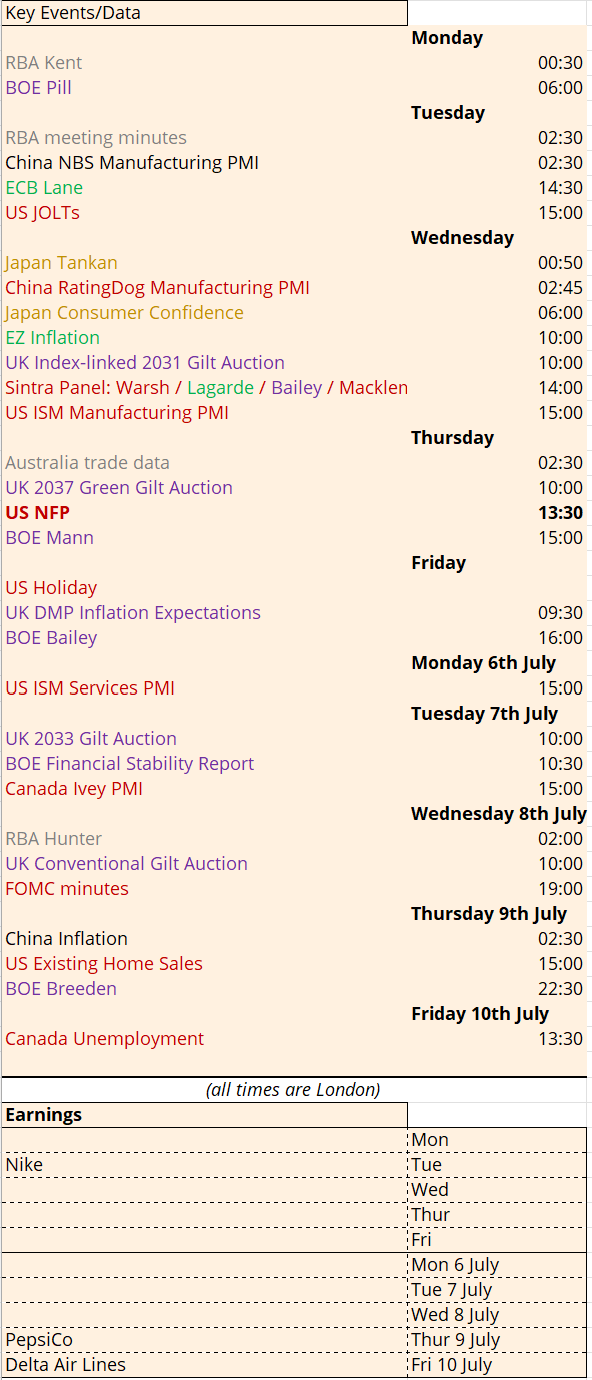
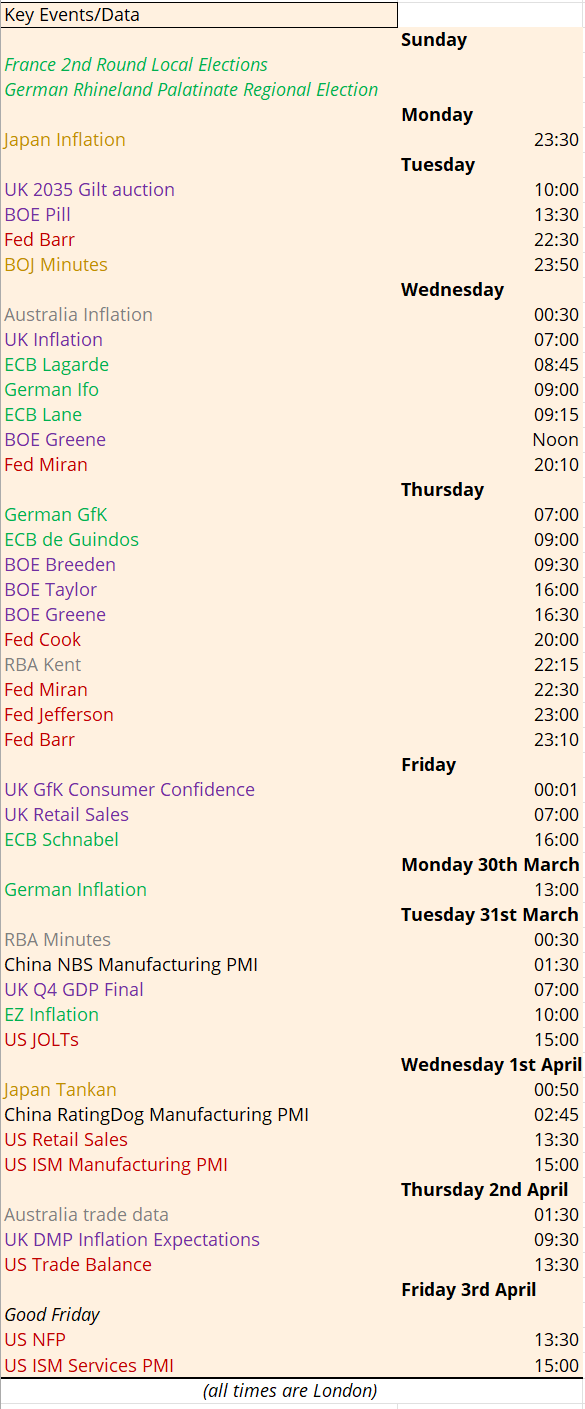
If this were a normal two weeks, we would consider the slew of central bankers explaining their about-turn from contemplative doves to inflation expectation hawks (ECB Watchers Conference on Wednesday and BOE speakers Thursday); we would reflect on the volatile outcome of the German regional election in Rhineland Palatinate where the AfD doubled their vote share while the SPD vote collapsed after ruling the state for 35 years; and we might flag up bellwether data points such as inflation in the UK on Wednesday and Eurozone on Tuesday 31st March, the Tankan for Japan on Wednesday 1st April, closing with a potentially volatile US Non Farm Payrolls print on Good Friday.
But these are far from normal times.
The markets are on a collision course as economic reality smashes into political rhetoric. No ceasefire, no interest rate change, no statements, no treaties, no tweets can stop what is coming: a stagflationary shock as the global economic system is redrawn almost overnight. Oil barrels are gone. Fertiliser will barely make its way onto crops in the agriculturally available window. Tankers are stranded or slowly rerouted. Flight schedules are permanently shifting with planes out of sync across the globe. The cost of doing business just shot up, everywhere, all at once.
And a market lulled into “Don’t Get Caught Short” by years of policymaker intervention is about to price in the two-way reality of a world that contains downside as well as upside risk. There cannot be Whatever It Takes.
Not least because what it takes is returning 8mm barrels of oil a day into an ocean Strait paralysed by fear. That fear will persist for some time to come. As the US Joint Chiefs General Dan Cain put it “even one Iranian soldier or militia member zipping across the narrow neck of the strait in a speedboat could fire a mobile missile right into a slow-moving supertanker, or plant a limpet mine on its hull”.
Even the release of petroleum reserves will only deliver a draw of 2mm barrels per day to start with. And as each day passes, the commodity losses are cumulative: LNG, sulphur, fertiliser are not getting to where they need to go. Unwinding the back-up, even if there were a ceasefire between all parties (not just the US-Iran axis), will take weeks if not months. Inflation of basic goods is here to stay.
And so monetary policy cannot easily do the lifting, with rate cuts being priced out across the developed world. Although stagflation does lead to demand destruction which might open the door to easing, central banks are still recovering from accusations they were behind the curve on the last inflationary impulse. And that recent episode not only weighs on central bankers but also on the general public. Once inflation bitten, twice toilet-roll-stockpiling shy. The central bankers simply cannot let inflation expectations get out of control, as each made clear in their recent meetings:
- Andrew Bailey: “The recent experience of high inflation may also make households and businesses more sensitive to a new inflationary shock“
- Jerome Powell: “it’s been five years, and we’ve actually had — we had the tariff shock, we had the pandemic, and now we have an energy shock of some size and duration… And it’s one of those things where it’s, it’s a repeated set of things and you worry that that’s the kind of thing that can — can cause trouble for inflation expectations and so we worry a lot about that. And we are very strongly committed to doing what it takes to keep inflation expectations anchored at 2 percent“.
- Christine Lagarde: “inflation expectations have a lot to do with the memory that people and corporates have of inflation. And back in 2022 the memory was dating way back. Now the memory is rather fresh because people have seen inflation. So the reaction function that they will have in terms of investment, in terms of wage negotiations and in terms of consumption is going to be informed by a fresher memory of inflation that went high and that we managed to bring back to 2%“.
But monetary policy can’t move the dial when a shortage of fertiliser might exponentially reduce the yield of essential food crops. With April of this year fast approaching, we are entering the key period for South Asian nations to import and stockpile fertiliser so it can be sown in June for harvest from September. This agricultural window can’t be budged by a tweet or an interest rate cut. A decision to move only to organic farming in Sri Lanka in April 2021 meant inorganic fertilisers were banned, devastating rice and tea production, sending prices soaring, leading to protests and the inevitable collapse of the government.
If that feels like a far-out conclusion in a far-away land, consider how fiscal policy is already constraining western governments. Energy bailouts for consumers might have been possible in the hugely-interventionary Covid-era lower interest rate world but in the high debt, sticky inflation, normalised interest rates of 2026 there is far less room for maneouvre. Nobody seems to have told the UK Labour Party however, with left-wing cabinet sources telling the Times “it would be politically impossible for a Labour government to offer people less support during a time of need than the Tories did”. Except that this government is issuing more Gilts than it even did in the Truss era – and at higher interest rates:

The government seems to think it has time on its side, with the quarterly energy price cap already kicking in at lower levels from April. While it waits, European nations are taking action, albeit mostly temporarily (h/t @Velina Tchakarova for the list):
- Italy, Austria and Slovenia have cut fuel duties, Spain has cut VAT on fuel, Portugal is ready to electricity prices above a certain threshold, Greece has capped profit margins on fuel, Slovakia has set higher fuel prices for foreigners, and Croatia has capped fuel prices.
But the UK is in a particularly toxic position with higher than average energy prices thanks to poor past policy decisions, dismal debt-deficit dynamics and a weak dysfunctional government. The Prime Minister might still be Keir Starmer but he isn’t the one making decisions. Immigration policy is made by the Home Secretary but unwound by the former deputy prime minister; foreign policy is determined by vetoes from the Energy Secretary; and devolution of taxation is announced by the Chancellor but backed by the (wannabe PM) Mayor of Manchester. It’s a free for all. Lisa Nandy might be the first, but she will not be the last, Cabinet minister to argue for a “rethink” of the fiscal rules to fund a cost of living bailout.
This is not a government in charge of its own destiny. There are reports of fury towards Trump that his “war knocks off course their hopes of the economy turning a corner this year“. Note it is only a hope, rather than a plan, for the economy. Sitting and hoping it will all be alright is rarely sensible political, let alone economic, strategy. A popular leader might get away with it. One sitting on a huge pile of debt as interest rates rise is liable to get washed away by events, dear boy, events.
Forget challengers for the Labour leadership. That’s fast becoming a side note of history. An incipient fiscal crisis could see the entire government fall. It has been a struggle to stick to welfare reforms whilst increases in inheritance tax and business rates announced in Budgets couldn’t be implemented. How will they manage to agree on a fiscal package that pleases the left of the party, the general public AND financial markets?
Particularly in a crisis situation. We are already at a point where petrol rationing and lower speed limits are being – sensibly – discussed as contingency plans in a serious fuel shortage. The UK has 26 days’ of petrol supply at normal demand levels. Petrol tends to lend itself to bouts of mania – in September 2021, there was panic buying in the wake of BP reporting 100 forecourts were short of at least one grade of fuel due to a shortgage of HGV drivers. It didn’t matter that this was only a fraction of its 1,200 outlets, within a week 26% of Petrol Retail Association members said they had run dry. Petrol is also politically toxic. The 2000 fuel protests led to the popular first-term Blair government dropping in the polls from a lead of 10 pct pts over the Tories to a deficit of 5 points. And now we are in a world where the cost of living has barely ever left the top of the list of voter concerns. We are literally at a combustible crossroads.
Political risk has mostly been ignored ever since Liberation Day penalised short sellers with the extreme 90bp premium recorded in the SPY ETF. Since then the VIX index has barely closed above 25 – until the assassination of Ayatollah Khamenei three weeks ago. And once we go above there, the downside left tail roars back into the potential distribution of outcomes. The UK Labour government might have been given the benefit of the doubt in a world that didn’t want to get caught short. But the calculation has now changed.
With a greater chance of a swing to the left tail, volatility will also increase. That creates its own ratchet, forcing de-leveraging as risk models take it into account. Cash levels in the BofA Fund Manager survey have already increased sharply, the largest single month increase since March 2020. But at 4.3% they’re not yet at the 5% threshold that BoFA uses as a buy signal.
And the usually calming effects of long gamma disappeared last week due to large options expiries. It will not take much to knock this market over. A 10% correction in the S&P500 would only take us back towards the 5,800 levels of last May.
The liquidation has begun. Don’t Get Caught Long.