The Christmas and New Year Weeks That Will Be

1. The UK
Parliament might be headed into recess but politics is not. Whether it’s Wes Streeting passionately defending “Labour values” in an interview to the New Statesman, or Angela Rayner reportedly backing rebels who want to prevent the reduction of jury trials, or, indeed, Andy Burnham apparently finding a “nailed on” seat to return as an MP, the runners and riders continue to jockey for their place in the inevitable leadership challenge. The Streeting faction would like someone to fire the starting gun ASAP, given Rayner remains mired in HMRC taxation settlement and time is not on Burnham’s logistical side. But campaigns require momentum and the British public will be distracted by festivities until the hangover kicks in. Parliament returns on Monday 5th January 2026.
One matter remains unanswered before the year runs out. Did the Prime Minister and Chancellor mislead financial markets during the Budget process? Both have been at pains to say they did not, despite briefings to the contrary.
- The Chancellor told the Treasury Select Committee that the 13 November FT story “Starmer and Reeves drop proposal to increase income tax rates in the Budget”, which caused a spike in Gilt yields, “was not an “off-the-record briefing; it was a leak”.
- But not one that came from her or her officials: “I am absolutely categorical that that was not an authorised briefing… It was not “briefing” that was signed off by me or any of my Ministers or officials“.
- …which led TSC Chair Meg Hillier to ask the Prime Minister at the Liaison Committee, “Do you think there was a leak from No. 10?”
- To which Starmer replied, “I have no reason to think there was a leak from No. 10“.
There is a looming implication from all of this. Somebody told the FT something that moved the market. Given Starmer and Reeves have ultimate responsibility for their staff, they might need to fall on their swords once the facts are revealed.
- Meg Hillier asked the Chancellor whether the resignation of the Chair of the OBR showed that “when organisations – advertently or inadvertently – leak market-sensitive information, the honourable course of action is for leaders of those organisations to resign?”
- Reeves did not respond directly to this question.
- Hillier asked Starmer “So you would go as far as removing an individual if they were found to have leaked the Budget?”
- He replied that he would “take appropriate action if there is a finding“.
Hillier knows the enquiry is unlikely to resolve matters, writing in the i Paper that she was “sceptical” it would “produce much-needed clarity“, but we can at least already conclude that the government is not in control of its communication to financial markets.
- Reeves only served to confirm this in her muddled explanation of the events between the final OBR pre-measures forecast of 31 October, her “scene setting” speech of 4 November that lit up speculation of income tax hikes and the 13 November FT story.
- She said the leak led markets to doubt her “strategy”:
- The implication of the 13 Nov leak was “that I had ditched core elements of the Budget strategy that I had set out just a few days before in the speech on 4 November and that I was not going to build up the headroom that I had previously said was necessary”.
- And so she issued a rebuttal:
- “That was not true, so both the Treasury and No. 10 issued statements on 14 November on the record to the press, to be clear that the Budget priorities stood, including building more resilience into the public finances, with headroom to withstand global turbulence”.
- She said the leak led markets to doubt her “strategy”:
Except this is not the full story.
- The markets had heard of an OBR productivity downgrade, cited by Reeves in her 4 November speech, and concluded that income tax hikes would be the surest way to fill the gap AND increase headroom.
- Without them, it appeared she had failed. Hence the back up in Gilt yields once the income tax hikes were ruled out.
- But we now know that there had already been an upgrade to wage forecasts which offset the productivity downgrade, enabling a politically more palatable course of action.
- Gilts calmed down once Bloomberg ran the 14 November story “Reeves’ tax U-turn came after better forecasts from UK watchdog”.
- But those forecasts didn’t come between 4 November and 13 November – they were known about on 31 October.
- As the OBR’s David Miles told the TSC, the supposed ‘good news’… “did not exist”.
This is a mess. The problem is asymmetric information. Nobody knew the OBR’s forecasts, only what the Chancellor hinted in her “scene setting” speech and what was briefed to the media. Markets price in probabilistic shifts and fill in the gaps where the information is uncertain. She promised to bolster her headroom whilst a productivity downgrade ostensibly made that harder – except it turned out that it didn’t, but the market did not know that until Budget Day itself, given the OBR was the only organisation not leaking its information.
It is perfectly sensible to guide expectations – central bankers do it all the time – but politicians need to understand how markets work. They’re a wave to be surfed rather than a tool to be weaponised.
The government either does not or cannot understand this.
- Reeves referred to the “on the record” rebuttal of 14 November. This was a word salad that would barely register with markets:
- “The chancellor was very clear about addressing the challenges this country faces and her priorities in addressing those challenges – all of that stands. One of the objectives of the budget is to build more resilient public finances with the headroom to withstand global turbulence and to give businesses the confidence to invest”.
- Unsurprisingly the Bloomberg story that better OBR forecasts had changed the headroom calculation had more impact.
- Markets didn’t think she had, as she put it, “ditched core elements of the Budget strategy“. They thought she couldn’t make the numbers add up.
- Markets don’t need reassuring words about “building headroom” but hard quantitative facts.
- With the Chancellor having outsourced the calculations to the OBR, the market spent the entire period in the run up to the Budget only getting one side of the story.
The Chancellor did have a strategy. She did double her headroom. She pleased the left wing of her party by removing the two-child benefit cap whilst backloading tax hikes to the end of the forecast period. But the misleading communications in the three weeks running up to the Budget show that she is not the one in charge. Starmer and his advisers are reacting to political pressure, not economic constraints. And they have demonstrably failed to do so without causing market turbulence.
Given the political pressure is only set to increase with Labour languishing in the polls and increasingly recalcitrant MPs spotting their veto powers (one backbencher has already had the whip removed for voting against the tax on inherited farmland), markets should be vigilant for further volatility ahead.
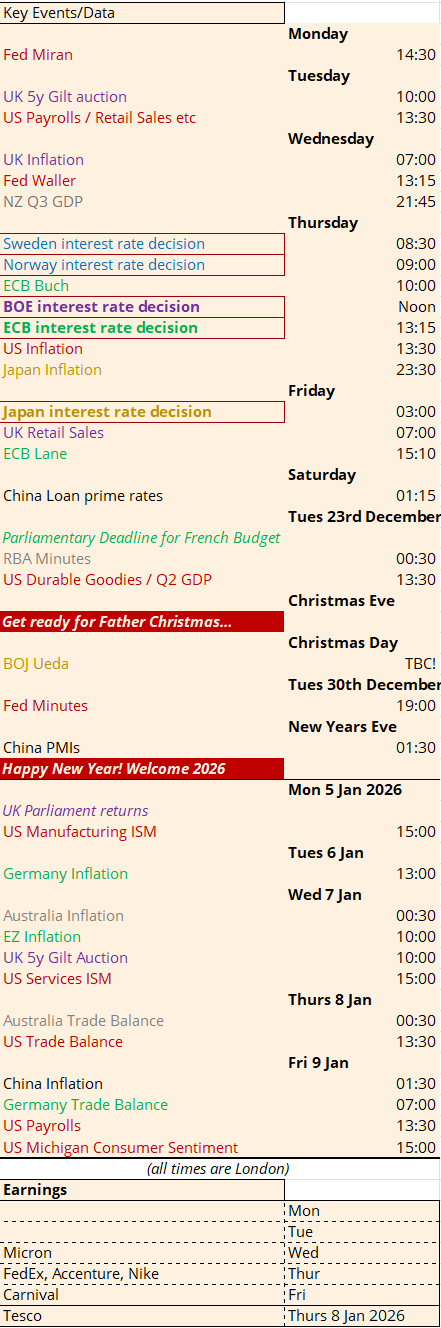
A small piece of good news could emerge for the Chancellor on Thursday when the Bank of England is likely to cut rates again. The Chancellor never misses the chance to talk of how her policies have led to lower interest rates. Indeed she gladly corrected Hillier at the TSC, triumphantly declaring that ‘I think the deputy governor [of the Bank] was a bit clearer than that. I think she gave evidence to the Committee yesterday saying that next year there will be 0.4 to 0.5 percentage points off inflation because of the measures in the Budget”. The message might be muddled in its execution but the Chancellor is sticking with it.
2. The ECB
The ECB have flipped the central bank narrative with recent hawkish comments from Isabel Schnabel that she was “rather comfortable” with market expectations that the next move from the ECB would be a hike, “albeit not any time soon“. President Lagarde did not dispel such expectations, noting recently that “the whole economy is faring better” and “my suspicion is we might [upgrade growth forecasts] again in December“.
This suggests a hawkish hold from the ECB on Thursday, rounding off a move towards higher European yields as the year draws to a close. The regulatory changes to Dutch pension funds that take effect from 1 January 2026 could provide some added volatility. These changes would tend to see steeper yield curves as Dutch funds exit long dated hedges and move out the credit curve, but the full extent of the flows won’t begin until we move into the new year. That won’t stop other players from pre-positioning during the most illiquid time of the year.
3. France
Added to this we have the deadline for the French Budget which must pass parliament by Tuesday 23rd December in order for the President to sign it off by the end of the year. This is looking increasingly unlikely given the wafer thin passage of the social security budget by 13 votes, the inability to agree on the text of the core budget and prime minister Lecornu’s stated refusal to use Article 49.3 to ram the budget through. Without an agreement, the budget simply rolls over on the same terms as the prior year, but it would be yet another sign that France still does not have a functioning government.
4. Germany
Germany can just about claim it is still functioning, having passed their budget, but not without a recent wobble over pension reforms that were part of the CDU/SPD coalition agreement. Chancellor Merz only just managed to achieve a majority, with 318 votes in the 630 seat Bundestag backing the pensions bill. Seven of his own MPs voted against the bill and one abstained. All of them were members of the youth wing of the CDU, six of them were new MPs and their average age was 32. They argued about the intergenerational unfairness of guaranteeing pensions at the current level of 48% of the average wage until 2031. One of the dissenters is the grandson of Helmut Kohl, suggesting that this particular group will not be silenced.
5. The BOJ
Having sent out the customary smoke signals, the Bank of Japan will increase interest rates on Friday. It would appear that Prime Minister Takaichi has made her peace with Governor Ueda, tacitly accepting that her proposed reflationary agenda might require a monetary offset, particularly with the Yen being so weak.
For those of you looking for something else to do on Christmas Day, you might cast an eye over Governor Ueda’s speech to Japan’s most powerful business leaders, the councillors of Keidanren. The time is still TBC, meaning you might not have tucked into the sherries before the Japanese Yen market opens.
6. The Fed
We will be greeted in the next week by a slew of delayed data from the US government shutdown, which will only serve to tell us whether the latest rate cut was justified rather than signal anything much for the future. Chair Powell seemed to indicate in his press conference that the payrolls data could come in on the negative side. But we will have to wait until Friday 9 January 2026 for up to date information, as that is when we will receive December’s payrolls number. Monday 5 January will bring the bellwether Manufacturing ISM.
Not that it matters very much. The Fed is in a state of flux.
- Stephen Miran, the most dovish and most recently appointed member of the FOMC, was due to exit on 31 January 2026 when his term ends, but now says he will stay on until his replacement is confirmed.
- We don’t yet know if or when Lisa Cook will be fired by President Trump, with oral arguments to be heard by the Supreme Court on 21 January 2026.
- The President has kept the game going over his choice for Chair, with family friend Kevin Warsh (married to the daughter of Trump’s BFF Ronald Lauder) now favoured over Kevin Hassett.
- But if Powell were to leave the Board of Governors, then the replacement could serve a truncated term, until Powell’s slot expires in January 2028.
- The Fed Minutes on Tuesday 30 December will only serve to flesh out the arguments behind the first three way dissent in six years.
At least we know that the regional Fed presidents will remain in place, having been unanimously reaffirmed (although there will need to be a replacement for Atlanta Fed’s Bostic who has already announced his retirement).
Whatever the personnel, the Fed is going to have to get more dovish.
7. And Finally…
The BM Team would like to wish you and yours an absolutely lovely festive season. We will be here should any significant shift take place. Rest assured we will be monitoring the horizon for icebergs so that you don’t have to. Relax and kick back with the turkey, stuffing, sherry and Quality Street. A Merry Christmas to us all; God bless us, everyone!