The End of Starmer
++ The end of Keir Starmer’s time as Prime Minister is nigh. It only awaits the proverbial last straw. Changing after the May elections will be too late. The Labour Party’s cold war must be resolved sooner rather than later or no remnants of the party will be left to meet the challenge of Farage ++
With Starmer still in post, a lazy assumption has developed that this is because it is too difficult to remove a Labour leader. This is incorrect.
- Labour Party rules have changed such that the leader can be challenged at any time.
- Before 2025, when in government it could only happen at party conference.
- The hurdle of finding 20% of MPs to back an alternative is not that hard.
- The recent deputy leader competition saw 316 Labour MPs happily declare public support for one of the candidates.
- Within a few hours of the contest being announced, the battle lines will be drawn.
- The public declarations for deputy leader came within 48 hours of nominations and within a week of the vacancy coming due, even though the departure of Angela Rayner was a surprise.
- The contest itself need not take more than 6-7 weeks.
- Both Deputy Leadership campaigns of 2025 and 2007 were completed within this timeframe.
- After Blair announced his resignation, ballot papers were with party members within a month.
- The party machinery is ready.
- The recent Deputy Leadership race means the NEC has had a dry run for the next contest.
- Being in government creates its own pressure to conclude the process efficiently and promptly.
- This will be the first change of Labour leader and prime minister for almost twenty years.
And yet there is a lingering fear that the contest itself will destroy the party. The Labour Party has only once changed its leader through a contest whilst in government (in 1976) and in recent times has had a near-death experience whilst doing so in opposition. The hesitancy to proceed is understandable.
But the Labour Party has nothing to fear from a contest. It is an opportunity as well as a threat. By candidates making the argument for their vision for the country, it means the eventual winner will have more of a mandate than the current prime minister. Everyone will know where the new leader stands and what their priorities are. There will be better party management as backbenchers will have declared their support and those who didn’t back the victor will have to fall into line. There will be a rump of disgruntlement but – importantly – the leadership will know who they are. The numerical majority will be smaller but stronger.
Time is the bigger threat.
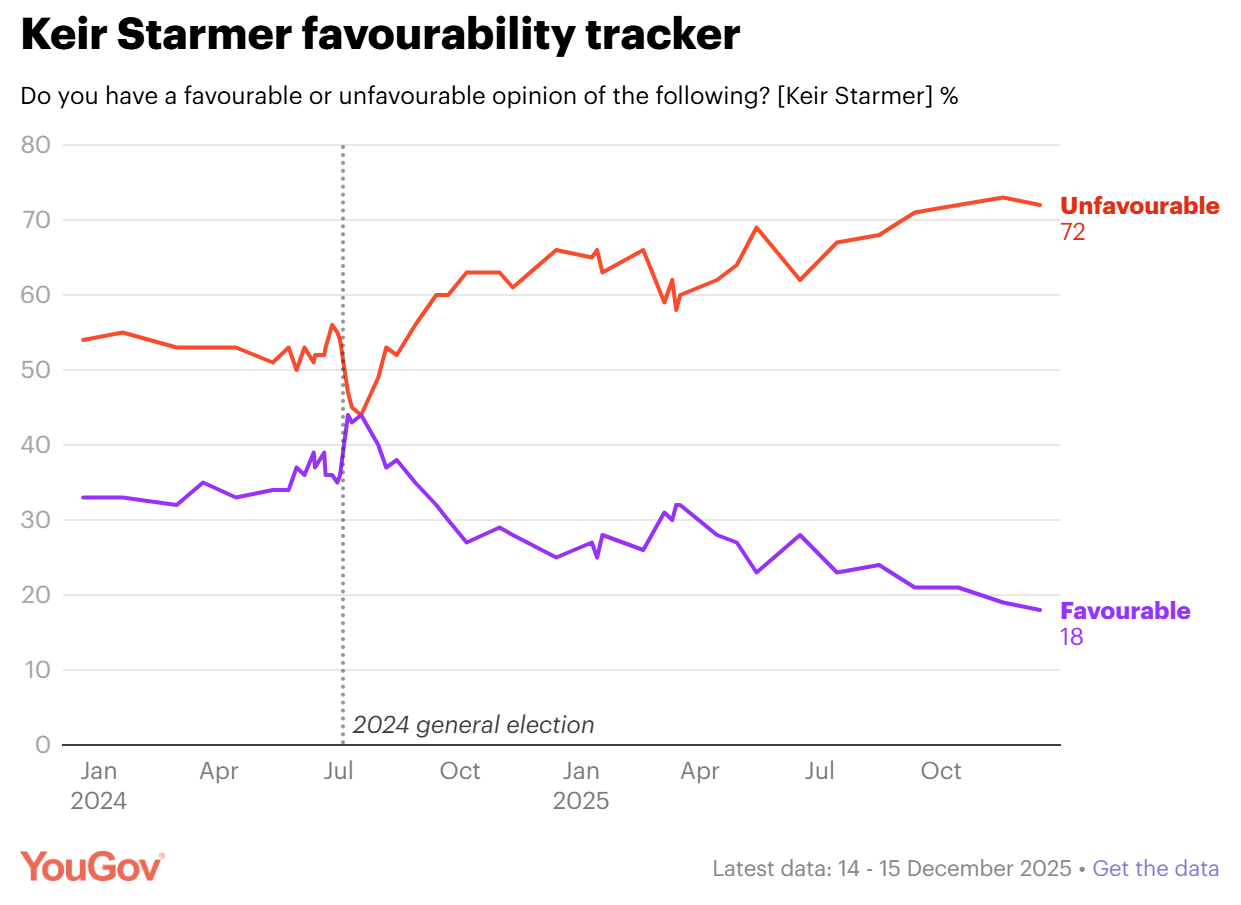
The Labour Party’s cold war is harming the party to the point of becoming an existential threat. Once Truss took the Tories below 20%, her removal was required to enable them to survive. Time will not help Starmer. Just like Rishi Sunak, the more voters know of Starmer, the worse he performs. Starmer’s current net favourability rating is as low as Boris’ on the day he resigned and at Corbyn’s lowest point as Labour leader.

Those fearful of a contest worry that changing leader looks chaotic. But keeping such a damaged leader who presides over a disunited party, flip-flops on policy and intervenes on a disastrous budget process in an attempt to improve an already impoverished Number 11 operation does not smack of competence. The voters have already made up their minds. With both main parties a mess, they’re choosing an alternative.
If Labour truly fear the threat of a Reform government then waiting for the May elections will be too late. Momentum is everything in politics. After any kind of victory the elections in councils, Scottish and Welsh assemblies, Reform will look like the government in waiting. Nigel Farage knows this, hence his exhortation to spend all the money they have as “it’s double or quits… we are just going to go for it… It is the single most important event between now and the general election“.
After that moment, Reform will gather even more money. They have already received the largest amount from a single living donor in British political history. They will have more ground troops in the form of elected representatives and local councillors. They are professionalising, as the recent ‘exclusive’ Telegraph article on “an insurgent force preparing for power” was at pains to demonstrate.
If Labour change leader now then they at least have a chance to reset the narrative and beat extremely low expectations. They can stem the bleeding and regain some momentum. They will keep some ground troops and reassure donors.
If they wait, the next leader will simply lead a lame duck government as Reform and the Greens thrash out the next election. Note that Kemi Badenoch’s waffly tweet in response to the removal of Venezuela’s Maduro had 670,000 views compared to Farage’s quicker and pithier comment with 4.5 million. She is technically Leader of the Opposition but there’s only one UK politician anyone is following.
Whether it’s Wes Streeting or Angela Rayner, the Labour Party – and the country – would be better served by a new leader with a new mandate. Lucy Powell, as deputy leader, can become a de facto Graham Brady, able to provoke a contest at any moment if she herself finds 81 MPs to nominate her. She could even be the stalking horse that ends up heading the cabinet table. Or the candidates might do a deal that agrees on a new team without going to the Labour membership.
Either way, the Starmer premiership is almost over. For those who feel it’s too soon after an historic election victory, consider what happened to the Conservatives in November 2021 over the Owen Paterson incident:
- The government forced a hard three line whip onto an amendment that made many backbenchers queasy. The amendment passed but only with a fraction of the government’s working majority. Outraged newspaper front pages the next day forced a climbdown. It was the latest in a series of u-turns from the Prime Minister. One ‘usually loyal’ MP told the BBC that it was ‘moronically stupid’. As one very senior figure put it: “This has now become a question of the government’s judgment.”
It took another six months before this burgeoning discontent saw Boris Johnson step down as prime minister in the wake of the Chris Pincher scandal. But it was the point at which the rot set in and from which he, and the party, never recovered.
It came about after the Parliamentary Comissioner for Standards had found Conservative MP Owen Paterson to be in breach of lobbying rules and the Select Committee had recommended a 30 day suspension. If the House had voted to accept these recommendations, Paterson would have been subject to a recall petition and ultimately a by-election. Instead an amendment sought to kick the can down the road by appointing a committee to consider the right of MPs to appeal such decisions. This smacked of politicians rigging the rules for themselves. In the ensuing chaos, Prime Minister Boris Johnson u-turned and Paterson resigned, triggering a by-election anyway. The Conservatives duly lost North Shropshire, one of the most pro-Brexit seats in the country, to the pro-Remain Liberal Democrats. The seat remains in Lib Dem hands, despite the Tories having held it on all but one occasion in the prior 200 years.
When a leader has lost control of events, they are done. The camel’s back cannot be unbowed. It’s simply a case of awaiting the straw. This could take any or all of the following forms:
- Polling decline
- The Paterson debacle came almost two years after an historic election win led to a large majority in parliament. We are just a few months away from the same point for the current government.
- Boris shed 13 pct pts in that period; Starmer did the same in one year and Labour now sit 15 pct pts below their election share of the vote.
- From here, with more parties jostling for position in an increasingly disenchanted and fragmented electorate, it is hard for Labour to stem the bleeding.
- At 19% in the polls they’re already at Liz Truss levels. The Labour Party is facing an existential threat. Truss technically had two years left in the parliament; Starmer has three and a half.
- The Paterson debacle came almost two years after an historic election win led to a large majority in parliament. We are just a few months away from the same point for the current government.
- Loss of party support
- There is scant evidence that even the government believes in the power of its own majority.
- The day before Christmas Eve it rushed out a partial reversal of the so-called family farms tax by increasing the threshold for inheritance tax relief.
- The National Farmers Union President welcomed the u-turn, pointing out ‘We have had hours of calls with Labour backbenchers, particularly those representing rural seats, resulting in a rebellion with nearly 40 abstentions on the vote on Budget Resolution 50‘.
- The vote on 2nd December should have been a routine implementation of the measures announced in the budget. Aside from the abstentions, one Labour MP, Markus Campbell-Savours, had the whip removed for voting against it.
- Hardly a known troublemaker, he represents one of the most rural seats in the country. His father is a Labour member of the House of Lords, having been a Labour MP for twenty-two years in a neighbouring constituency. Losing Markus’ support for a key Budget measure does not bode well.
- The timing signals fears over passage of the bulk of the Budget as the next stage of the Finance Bill is due to be debated on 12th and 13th January.
- With a government so beholden to its backbenchers, discipline is going out of the window.
- On proposals to scale back jury trials, the MP Karl Turner has declared he would vote against the government for the first time if they proceed.
- He went on to organise a letter urging the government to change course, signed by 39 Labour MPs.
- On the controversy over the return to the UK of “abhorrent tweeter” Alaa Abd El Fattah, the new Labour MP Tom Rutland tweeted ‘It is unclear to me why it has been a priority for successive governments to bring this guy over here’.
- Whilst not a direct criticism of Starmer it is indicative of how many new MPs feel unshackled enough to speak their mind – and of how perturbed many felt about this topic to give it further oxygen before the government had itself dictated the line to take.
- On proposals to scale back jury trials, the MP Karl Turner has declared he would vote against the government for the first time if they proceed.
- In recognition of discontent, the Prime Minister is attempting to dole out patronage.
- Anneliese Dodds, his first choice as his Chancellor who subsequently left her ministerial position over the reduction in international aid to pay for increased defence spending, has been made a Dame.
- Starmer is reported to be considering bringing back Angela Rayner, Louise Haigh and/or Lucy Powell to the cabinet.
- Election loss
- An actual election result feels like it should be the main reason for a prime minister to depart.
- It rarely has such an immediate impact.
- Theresa May clung on for two years after losing her parliamentary majority in a disastrous election decision. John Major survived for four more years after losing the Newbury and Christchurch by-elections.
- Labour have already suffered electoral losses.
- Runcorn and Helsby fell to Reform.
- With Plaid Cymru taking the Welsh Senedd seat of Caerphilly, Labour lost more than a hundred years of representation in the seat.
- Fiscal turbulence
- The market has been remarkably forgiving of a government with no mandate for the fiscal actions it has taken and that has suffered u-turn after u-turn.
- Bank of England rate cuts, relatively better attempts at fiscal consolidation than other G7 nations and generally buoyant risk appetite have helped the UK government avoid too much turbulence.
- The market has been remarkably forgiving of a government with no mandate for the fiscal actions it has taken and that has suffered u-turn after u-turn.
Despite the polling decline, loss of party discipline, electoral defeats and occasional market wobbles, the final straw has yet to land.
- Events, Dear Boy, Events
- A ministerial resignation; constituency parties withdrawing support; or simply a gaffe can tip the balance.
- Can’t eat a bacon sandwich? Keir Starmer sits in front of a plate of baked beans.
- Abhor tweets but blame someone else for failing to vet the tweeter?
- Complain how it is hard to pull the lever on delivering change twelve months after saying the same thing to the same parliamentary committtee?
- Demand the return of the sausages rather than hostages?
- A ministerial resignation; constituency parties withdrawing support; or simply a gaffe can tip the balance.
The Labour Party might have little experience of changing the prime minister but events will force their hand.