The Summer That Will Be 2026


1. The UK
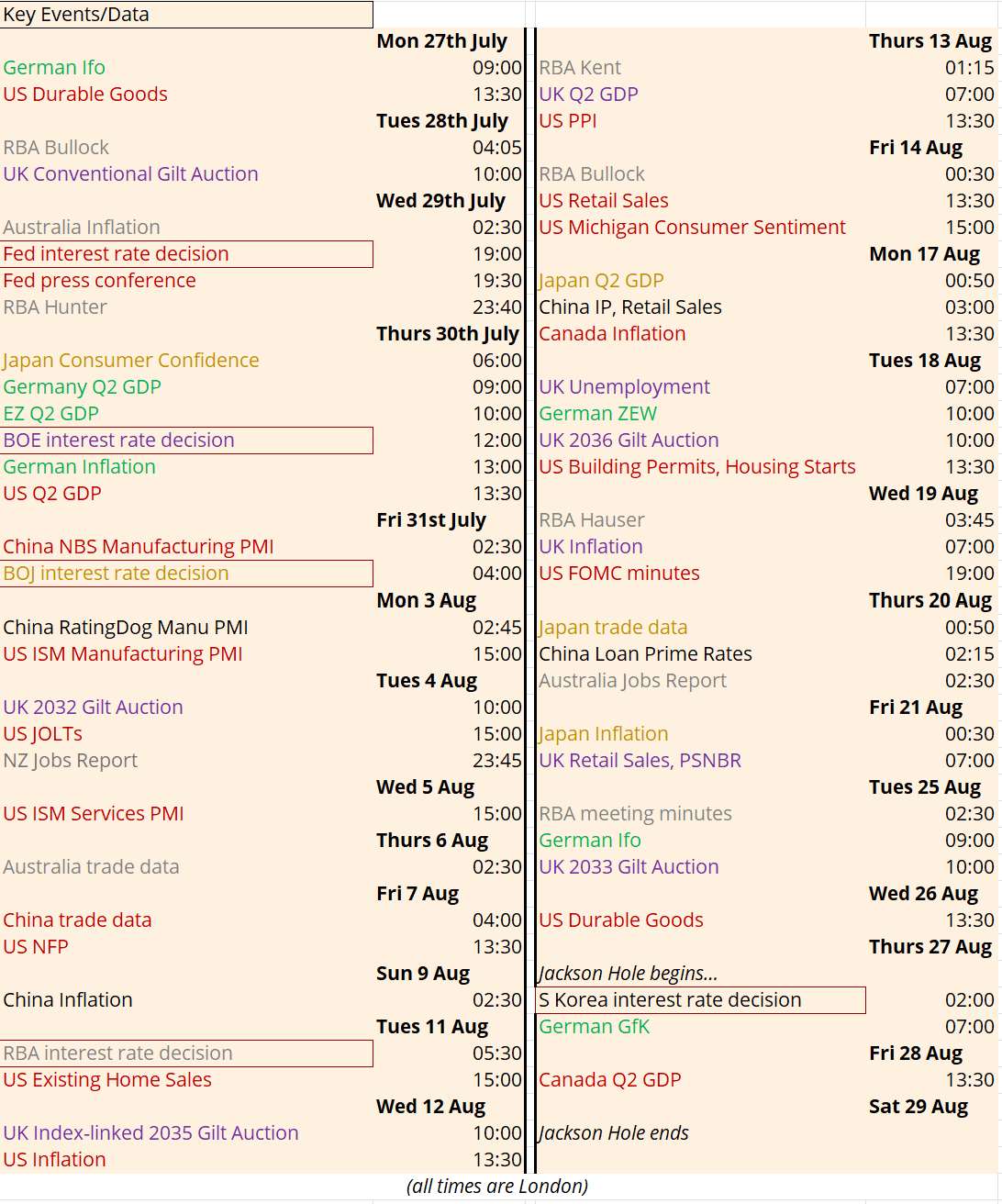
The summer is Andy Burnham’s. Free from the shackles of parliamentary scrutiny and the oppressive Westminster bubble, he won’t get a much better chance to dominate the airwaves. But even with all his TikTok expertise, he can only hint at his priorities as the lingering question of how to pay for them will persist until his inaugural budget is delivered. We should get an announcement of the date soon: the forecast process for the 30th October 2024 Budget was requested from the OBR by Reeves on 29th July.
With potentially significant fiscal change ahead, the Bank of England will prefer to leave rates unchanged on Thursday 30th July. They can use the accompanying quarterly Monetary Policy Report to flag up inflationary risks and/or expand on the potential systemic risks posed by AI that they mentioned in their latest Financial Stability Report, such as the hyperscaler cash burn:

2. Earnings
The BOE provided an early warning. The chart above was released on 7th July; a fortnight later, Alphabet reported their first ever quarter of negative free cash flow:

In this environment, the most important events of the whole summer will be the release of the rest of the big tech earnings:
- Microsoft, Meta – Wednesday
- Apple, Amazon – Thursday
And the big daddy of them all comes on Wednesday 26th August with Nvidia reporting.
Before that we have the small matter of the first earnings release from SpaceX since it went public on Tuesday 4th August. This would be important enough given the speculative frenzy that greeted its IPO but its valuation has a knock on impact as many of the MAG7 are shareholders. Alphabet’s earnings contained the revelation that it holds a ~4% stake in SpaceX, worth around $94bn as at end of June. This valuation contributed to a huge beat on Alphabet’s earnings per share. So huge, it caused concern that perhaps this was all just an unsustainable circle, with hyperscalers investing in AI that provides AI for the hyperscalers. If it feels like a house of cards, that’s because it is. But the game keeps going as long as valuations rise and cash can be raised to keep burning through AI capital expenditure. That may not last. SpaceX has a vulnerable quirk over the illiquid summer period because lock-up periods on the shares expire, starting on 6th August.
Throw in the ongoing leveraged play on the entire AI story through South Korean single stock semiconductor ETFs and there is a risk of significant summertime volatility. The KOSPI has now seen seven circuit breakers triggered this year, almost the same amount as over the entire prior 25 year period. There have been 34 sidecars, where sharp moves in futures result in the suspension of programme trading for five minutes, which is significantly more than the 26 which took place in 2008. The South Korean regulators have tried to put the genie back in the bottle by tightening regulations. After all, this is the country that was the first to ban short selling in the wake of Lehman’s going bust in 2008. But this latest adjustment is likely to exacerbate the problem. Within the various measures is what they call “Strengthened tracking error management” which will penalise ETF providers if their ETFs deviate too far from the underlying. This incentivises providers to trade more, not less, when there are big moves in the likes of Samsung and SK Hynix, increasing the pro-cyclicality that caused the problems for the KOSPI index in the first place. And if the exchange does kick out an ETF issuer, that will make matters worse by removing a liquidity provider. South Korea is rapidly becoming not only the canary in the AI coalmine but one that is singing loudly.
We are undoubtedly in a once-in-a-lifetime period of astonishing innovation but history is littered with genuine technological advancements that run out of road (or rail) due to capacity constraints. According to this chart from Goldman (h/t Bob Elliott of Unlimited Funds in his latest substack) the outperformance of equities vs bonds in the last decade is more extreme than that of the 1920s and dot-com boom 2000s:

3. War
Part of the disconnect between equites and bonds comes from the increasingly inflationary macroeconomic picture due to the ongoing Middle East conflict. Where equities have been largely sanguine, propelled by the perma FOMO AI excitement, bonds are primed for weakness as inflationary pressure persists. The dominoes from the initiation of hostilities over Hormuz have already fallen. China might have switched refinery production and ramped up yields so that it imported less oil, keeping something of a lid on oil prices, but it didn’t magically spread fertiliser over Asian crops. This will eventually manifest in higher food prices down the line.
Meanwhile the buffers to deal with an ongoing conflict have been run down. The US Strategic Petroleum Reserve has fallen by half in five years as @CharlieBilello points out:

The US is running out of missiles, the New York Times reports, forcing a pause in escalating strikes. The Houthis are trying to stop Saudi ships from passing through the Bab al-Mandeb strait. The Iranians are threatening RAF Fairford as a “legitimate target” as it’s used by US aircraft and personnel. An oil tanker has exploded in the Strait of Hormuz after colliding with an Iranian mine after, according to the Iranians, deviating from the Iranian route. If the US President felt he could keep the war going at $70 a barrel, the Iranians appear keen to test his resolve at $120. Either way, the war is far from over.
4. The Fed
Into this pivotal period for both AI and inflation, with equities and bonds priced for entirely different outcomes, the Fed will stand pat at their meeting on Wednesday 29th July. At some point the new Chair will want to spring a surprise but until then he will want to retain optionality. Expect a brief and brisk meeting. The Minutes of the meeting which are released on Wednesday 19th August might shed some light on the division on the FOMC but, as Kevin Warsh has been keen to remind us, the Fed is not a democracy.
He wants markets to focus on the data and make up their own mind about what monetary policy should do. Key data points over the summer include the ISM on Monday 3rd August, Payrolls on Friday 7th August, Inflation on Wednesday 12th August and Durable Goods on Wednesday 26th August. Jackson Hole begins that day and concludes Saturday 29th August but with Warsh firmly in the camp of providing no forward guidance, we expect the annual symposium to go back to being a talking shop rather than signalling device. In any case, the title of this year’s suggests it’s going to be rather more about crypto and stablecoins than grand macroeconomic academic policy: “Financial Innovation: Implications for Payments and Policy”.
5. Japan
As if there weren’t enough tinder underneath financial markets, Japan might well provide the spark. The currency and bond prices are at multi-decade lows with, whisper it, poor debt-deficit dynamics running headlong into a fiscally stimulative government. Shorting JGBs, the widow-maker trade of the entire 21st century, might finally make sense. The new annual economic blueprint from the Takaichi government radically departs from fiscal conservatism:
- It allows for deviations from primary budget surpluses, instead aiming to get debt-to-GDP on a downward trajectory, in order to enable to spending on projects that span across many years
- A separate investment framework for certain projects will have no ceiling and will be financed through “temporary” government bonds
- The government will focus investment on 17 strategic sectors, targeting public and private investment of 370 trillion yen by 2040

All of this, Takaichi argues, will enable the government to target 1% real GDP growth and a doubling of total factor productivity. Unsurprisingly this entire programme has eradicated the phrase used in last year’s blueprint by her predecessor: there is no mention of “fiscal consolidation”.
This should prompt interest rate rises from the Bank of Japan, possibly even at their next meeting on Friday 31st July. The US Treasury certainly thinks so, saying in its latest semi-annual currency report that “[Japanese] Monetary policy normalisation would help anchor inflation expectations and reduce excessive exchange rate volatility“. That might support the currency but at the cost of losing the bond market. And where Japan goes, other similarly indebted nations will fear to tread. Andy Burnham should enjoy his summertime honeymoon while he can.