The Two Weeks That Will Be (13th July 2026)

1. The UK
Andy Burnham will become prime minister on Monday 20th July and Ed Miliband will be the new chancellor. Despite parliamentary recess, expect a flurry of potentially chaotic activity from the new administration. Burnham reportedly “wants a Bank of England moment” akin to the announcement of BOE independence within days of Blair’s landslide victory. Louise Haigh hinted at adding growth to the BOE’s mandate in her new fiscal framework; Miatta Fahnbulleh wants to act “immediately” on a package to help the poorest with “more money in their pockets”; and Lucy Powell is hoping to be the deputy prime minister despatched to her home turf in Manchester to run No10 North.
The countdown to the budget will begin. We expect it will take place at the earliest opportunity on Wednesday 14th October, even as there is talk of it being expanded to include a fresh spending review. This would enable Burn-Band to reprioritise between departments, which is partly already necessary because of the hospital pass from the Defence Investment Plan. John Healey resigned over what he felt to be inadequate funding; his successor as defence secretary, Dan Jarvis, acquiesced to an adjusted deal which the Treasury explained would be ‘funded’ as follows:

Just the £5bn black hole then. If you have to find that, you might as well reshuffle the pack between departments, not least as there will be a personnel reshuffle at the same time. Not in all roles however: David Miliband appears to realise Yvette Cooper will remain as Foreign Secretary as he is now gunning for the role of US Ambassador.
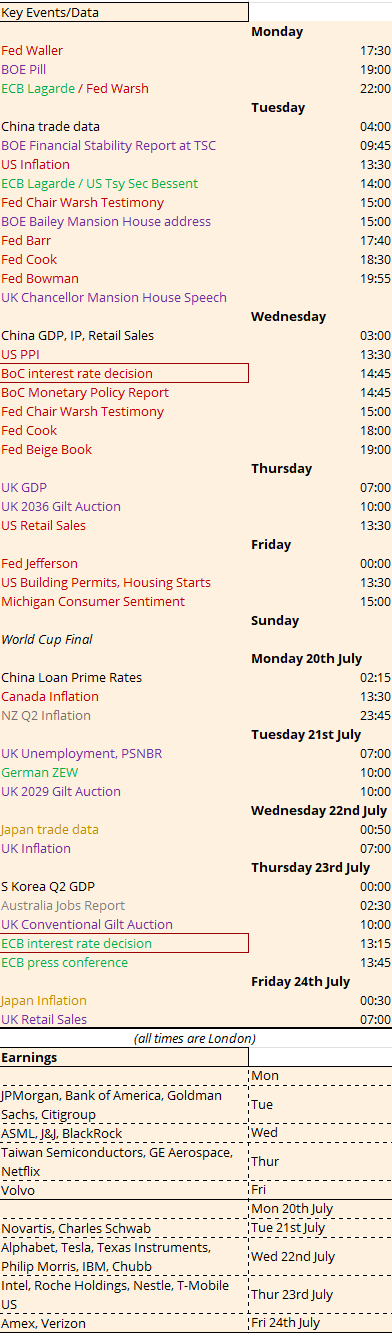
All of this renders the Reeves Mansion House speech on Tuesday redundant. Two key data points of the utmost importance will survive the Downing Street changes however: the PSNBR on Tuesday 21st July and inflation on Wednesday 22nd July. Burnham will be just as constrained by the huge pile of debt as his predecessor although his team might find both a better way to flex the rules and to spin the outcome.
He might well have an early filip if the Three Lions can purge sixty years of hurt on Sunday. Snap election chatter will ride the coat tails of the euphoria that would accompany the return of (what we will always call) the Jules Rimet to its rightful home.
2. The US
Back before the dots and Faustian forward guidance, the main tool by which the Fed Chair explained the economic outlook was through a twice-yearly appearance in front of Congress. The Humphrey-Hawkins testimony used to be a key communication staging point for the Fed, keenly parsed by markets along with its accompanying Monetary Policy Report. The statutory requirement to provide the report and testimony remains in place but the entire event has largely been sidelined following increased FOMC transparency which culminated in press conferences at every meeting under Jerome Powell. But now Kevin Warsh will be tempted to go back to the future. We already know he wants to revamp communications in order to break the increasingly endogenous link between market pricing and Fed reaction function. He said at his first meeting in charge “Financial market prices are probably the most important source of information to guide central bankers. But when all the financial markets are doing is reflecting back what we’ve said, then we’re taking the most important source of information, and we’re being blind to it“.
His testimony on Tuesday to the House and Wednesday to the Senate will provide the perfect opportunity to shake things up. The Monetary Policy Report has already been filed with Congress, early. Equally unusually, it has not been signed by Warsh, suggesting he does want to stand apart from the committee.
He said in the January 2007 FOMC meeting that he favoured the “benevolent leader” model for the Chair. He clarified that this fell between two other options: “a “benevolent dictator” model in which we all say, “Hey, Chairman, here are our best views; they are all yours.” Nor is the model a pure democracy, where all nineteen of us parade, “These are my numbers. This is my view of the world”. He concluded with specific reference to the semi-annual Congressional appearances: “I don’t view the Chairman, in his testimony or in his announcement of projections, as the press spokesman for the FOMC“.
Some are more equal than others and the Fed is not a democracy. He wants markets to listen to the Fed Chair. Not to spoon feed them the price but instead to get them to stand on their own two feet.
The Fed reaction function has a part to play in this but it is not the only factor; the market could take a view on the direction of the economy and based on incoming data determine that the central bank is making a policy mistake. Which in itself might reduce the risk of such a mistake. In Warsh’s world, inflation on Tuesday, the Beige Book on Wednesday,Retail Sales on Thursday and the Michigan survey of inflation expectations on Friday should be weighed by the markets more than the forecast of an FOMC participant.
And all of those data points are in any case vulnerable to the fact the global economy remains vulnerable to geopolitics. It doesn’t matter much what the Fed’s reaction function is when supply lines of key global commodities are being redrawn for the first time in decades. Rather than obsess over Warsh failing to offer his forecast for inflation, the market should instead determine its own view on oil prices from the persistent closure of the Strait of Hormuz. Both President Trump and the Iranian Revolutionary Guard are hardly known for their soothing and conciliatory approach. The latest iteration of traded missile blows and arguments over tolls will not be solved in a heartbeat.
3. Earnings
But markets power on, driven by the all-consuming AI behemoth.
South Korea is currently looking extremely canary-like in the financial markets coalmine. The approval of single stock leveraged ETFs by the regulator in May has helped to quadruple daily trading volumes on the benchmark KOSPI index. The FOMO mania into hot semiconductor stocks like SK Hynix has forced mechnical pro-cyclical flows from the ETF machines, exacerbating both the up moves and the downturns. The KOSPI has suffered seven trading halts this year, triggered on a drop of more than 8%, out of a total of thirteen times since 2000. On Monday it had its third biggest drop since Lehman went under.
Margin trading has risen with Bank of Korea calculating that leveraged investments by retail investors into equities has reached a record $39bn.
As more shares become part of passive vehicles, the available pool for active trading shrinks. As we noted in our CityAM column, “Goldman Sachs, drawing on EPFR data, estimates that leveraged ETF exposure as a percentage of the free-float capitalisation of the underlying shares has risen from roughly 0.8 per cent at the start of the year to almost three per cent“.
The financial authorities are due to meet on Thursday to discuss possible measures for single stock leveraged ETFs. Lee Chan-jin, governor of the Financial Supervisory Service has already admitted “Maybe I should have lain down on the floor to block it. I personally regret I didn’t“.
Despite all of this, US earnings season begins. We will be watching the big investment banks on Tuesday, ETF bellwether BlackRock on Wednesday, Taiwan Semiconductors on Thursday and Alphabet on Wednesday 22nd July.
4. The ECB
ECB President Lagarde has finally admitted that she might well step down before her term officially ends in October 2027, telling a French newspaper an early departure is “possible” ahead of the French presidential elections. Marine Le Pen is now cleared to run in those, even as she was still found guilty and must wear an ankle tag (pending an appeal).
Lagarde wants to bring in the supranational dimension, saying: “I think a European voice must be heard in the French presidential debate. If this debate were to present a perspective that diminishes France’s place within Europe, I think it would be necessary to explain why this would be a painful path for our country and our citizens”. When asked whether this meant she would get personally involved in French politics, she replied “I’m going to ask myself some questions”.
She is going to ask questions of Warsh and Bessent first, on her trip to Washington this week, meeting the former on Monday and the latter on Tuesday. Then back to Frankfurt for the day job, with the ECB expected to remain on hold at their meeting on Thursday 23rd July.