Securonomics: Continuity, Evolution, and the Test of Crisis
From Vision to Execution
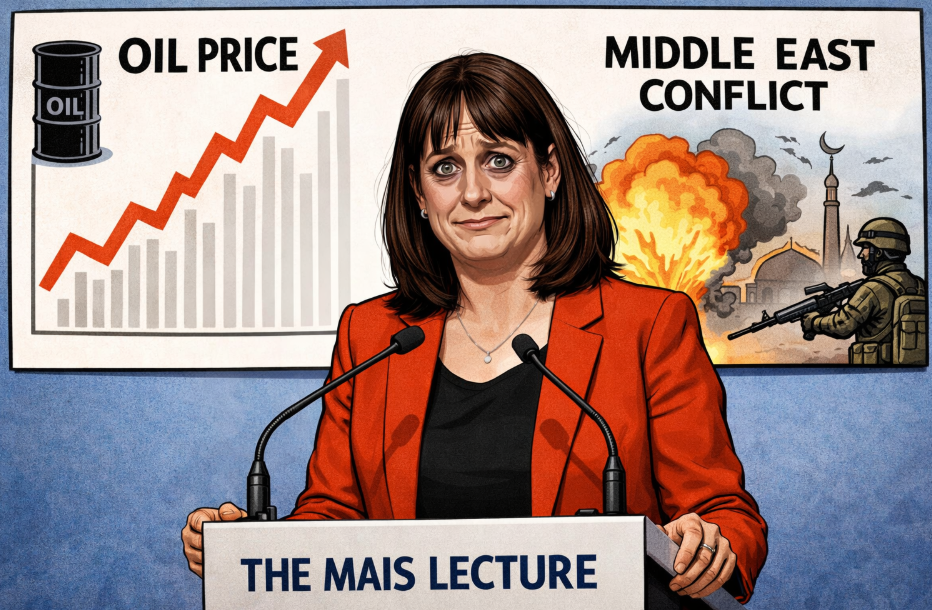
Two years after delivering her first Mais Lecture, Rachel Reeves returned to Bayes Business School on 17 March 2026 with what was billed as a progress report and reaffirmation of the Labour Party’s plan to combat the absence of economic growth. She continues to assert that an active and strategic state, built on the core pillars of stability, investment, and reform, is necessary to fight the “age of insecurity” plaguing Britain today.
Reeves steadfastly clings to her “securonomics” framework for growth amid global instability fuelled by the war in the Middle East, the ensuing energy crisis, and the ongoing climate crisis. She bluntly concedes that a severe lack of investment has delivered Britain the worst productivity performance in the G7 since the global financial crisis, while regional imbalances have widened and stop-go politics has steadily eroded business confidence. Securonomics features an active and strategic state working in partnership with business to deliver secure, resilient, and broad-based growth. The plan rests on three familiar pillars: stability as the foundation of credibility; public investment to crowd in private capital; and supply-side reform to mobilise land, energy, labour, and capital.
Where the 2024 lecture established the plan, made bold promises for the future, and sharply criticised 14 years of Conservative failure (especially the claimed 4% GDP cost of Brexit) the 2026 lecture doubles as a defensive justification of difficult choices already taken and a selective showcase of early “wins”: the fastest European G7 growth in 2025, £120bn+ in public investment unlocked, gas imports down by 17%, NHS waiting lists at a three-year low, the two-child benefit cap scrapped, and the energy price cap cut by £117. Tax increases were defended as a necessary evil to restore stability and fill a £22bn fiscal black hole.
These selective improvements notwithstanding, it is doubtful if securonomics has done enough to justify further steps in the same direction. After nearly two years of implementation, the core promise of the framework remains largely unfulfilled. GDP growth in 2025 was a modest 1.3%, a low-bar outperformance of struggling European G7 peers rather than an impressive feat. Household living standards and real wages have not seen tangible improvements amid persistent inflationary pressures. The government’s continued insistence on the same securonomics blueprint invites the question: if this active and strategic state approach is truly the transformative remedy Reeves has long argued it is, why has the economy not yet shown clearer, more convincing signs of acceleration and resilience after nearly two years of application?
Reeves points to advances in stability through tweaked fiscal rules that no longer penalise investment. The National Wealth Fund, Great British Energy, and Green Prosperity Plan are said to be on track, having unlocked £90bn in private renewables investment and restarted nuclear projects at Sizewell and C and Anglesey. The onshore wind ban has been lifted. The Employment Rights Act has introduced day-one rights while attempting to preserve some flexibility around zero-hour contracts. Planning reforms including mandatory targets, grey-belt release and new towns are progressing, and capital is being redirected from pensions and ISAs. Energy-intensive firms are being offered relief via a supercharger discount and the British Industrial Competitiveness Scheme.
Securonomics rests on the questionable premise that a centralised active and strategic state can outperform the dispersed knowledge of markets in allocating capital and managing risk. By “de-risking” favoured sectors through the National Wealth Fund and Great British Energy, the government transfers risk to taxpayers, creating moral hazard and distorting productive resource allocation. Meanwhile, policies portrayed as supply-side reform extract capital from the private sector and raise hiring costs, undermining the labour-market dynamism and entrepreneurship the framework seeks to promote.
The “Three Big Choices” for Growth
Yet the real emphasis of Reeves’ 2026 lecture falls on the “three big choices” she presents as make-or-break opportunities for Britain’s economic future. First, regional growth corridors: the Oxford-to-Cambridge Growth Corridor receives £2.5bn for East-West Rail, innovation hubs, development corporations, and even compulsory purchase powers to force city expansion. The Northern Growth Corridor will also see £15.6bn injected into city-region transport, the development of a Manchester Digital Campus, and a potential roadmap for fiscal devolution that could give local leaders greater say in the allocation of national tax revenues.
Second, AI sovereignty is being aggressively pursued through a £500m Sovereign AI unit, £5bn for British start-ups, Growth Labs for rapid regulation-free innovation, a ten-million worker AI Skills Boost campaign, a new AI Economics Institute, and a pledge to procure £1bn of quantum computers. This is all with the ambitious goal of achieving the fastest G7 AI adoption to prevent Britain falling further behind.
Third, Reeves looks optimistically to deepening alignment with the EU. She advocates for regulatory alignment when it is in national interest, stipulating that partnership must increase growth, be stable, align with British values, and not compromise economic or national security. She cites early progress in agrifood, electricity, and emissions schemes. Britain is even open to participating in EU loans for Ukraine and pursuing deals with non-European world powers such as the US and India.
Reeves has not abandoned the “securonomics” blueprint she set out in her first lecture, she has begun executing it. Labour under Reeves is attempting to position itself as the party of investment-led national renewal in an insecure world, with a focus on stable institutions, strategic public investment, supply-side reform, regional rebalancing, AI leadership, and pragmatic European partnership. The 2024 vision is being expanded upon, and the party is doubling down on their plans for growth through an active and strategic state in 2026.
These choices only amplify the underlying tensions. The push for sovereign AI risks creating an insulated, less competitive ecosystem by shielding domestic players from global pressures, while deeper EU alignment may tie Britain to a regulatory framework long criticised for stifling innovation, potentially at the expense of the agility securonomics claims to deliver.
The Test of Crisis
A far sterner test is however already unfolding. As the Middle East conflict has driven Brent crude oil prices above $110 a barrel and sent UK gas prices spiking to three-year highs, Reeves’ response will play a crucial role in shaping the future of Britain’s economy. Reeves assures that the government will work to secure oil through the Strait of Hormuz, protect the most vulnerable households reliant on heating oil, and repress any attempts companies make to increase profits in this time of crisis. While admitting that a resolution to the conflict remains the best-case scenario, she insists the answer lies in more securonomics: an active state reinforcing domestic supply, accelerating regulatory speed, and pursuing international pragmatism.
Options such as reducing fuel tax and cutting VAT could directly mitigate the spike in oil prices felt by consumers, but it is unlikely that Labour will make these uncharacteristic changes. The energy reforms Reeves mentions in her lecture may decrease long-term energy costs but will take time to implement, leaving ample opportunity for costs to rise before the reforms go into effect. It is probable that Labour will continue down the path of only giving support to those who are “most vulnerable” as they have already done with heating oil. Subsidising oil more broadly would likely mean increasing taxes, which would involve breaking the vow Reeves made that she “will not ask taxpayers to pay more.”
Labour now finds itself in a self-imposed straitjacket. The government can neither rush to the rescue with broad-relief aid without abandoning fiscal credibility, nor wait tentatively for the payoff of reforms to kick in without appearing to have abandoned the public in a time of need. A more realistic expectation is the release of public messaging urging people to have resilience and patiently await long-term economic growth. Voters will be forced to wait for tomorrow’s energy abundance while paying today’s inflated bills.
- By our intern Victoria Burchett