The Two Weeks That Will Be (4th May 2026)

1. The UK
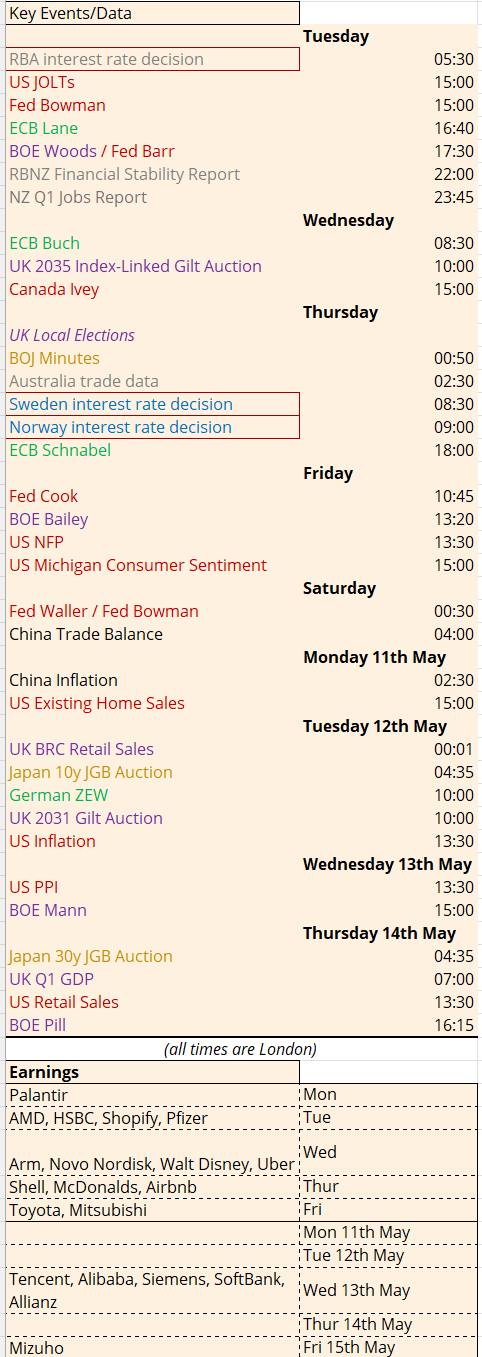
And so, the local election date finally rolls around on Thursday. It need not have been quite so pivotal if discontented Labour MPs hadn’t kept talking about it as the date by which they would finally be forced to dispense of their beleaguered leader. This is usually qualified by “if results are worse than expected”. Except that there is nothing so sustaining to those knocking on doors every day than the delusion that secretly, it won’t be as bad as expected. Otherwise, why pound the pavements at all? And so, when we see talk of what would constitute a “bad” night for the government, whether that’s the 1,500 losses of Rallings and Thrasher or 2,000 of Peter Kellner, party activists are secretly hoping for less than 1,000.


And that’s just the local council elections in England. There are far bigger stories unfolding in Scotland and – most totemically – in Wales. In the former, Reform are set to go from zero seats to as many as Labour hold now, moving into second place. In the latter, Reform are running close to Plaid Cymru, with Labour a distant third. Such an outcome should have been unthinkable. Labour has been the largest party at every Senedd election since devolution; Labour has also always won the most seats in Wales at UK general elections. Now, if polling is correct, Labour will be forced to back a Plaid Cymru first minister to prevent Reform from taking the crown.
At a time of fragmented electorates and a wider choice of candidates, the Welsh vote has an additional layer of uncertainty. They have moved to a new electoral system (closed party list proportional representation) and have increased the number of representatives from 60 to 96. Voters will have only one ballot paper this time rather than two, potentially complicating voter preferences. It is also a recipe for creating a minority administration, meaning that the matter of forming a government is unlikely to be settled promptly.
With Labour set to lose in their heartlands and disappoint their own expectations, there will be plenty of gloom upon which any leadership contender can capitalise. Except we have been here before, haven’t we? The reason Keir Starmer became and remained leader of the Labour Party has been his ability to play internal factions off against one another. As long as he wasn’t hated as much as a factional opponent, he can remain in place. Unfortunately being the “not quite as hated” person isn’t such a skilful position to take when becoming prime minister. It’s almost as if he wasn’t ready for government.
Neither were his party, who continue to plot against one another. Fratricide is an exhausting and distracting business, particularly when it doesn’t lead to any grand conclusion. Variously, we are now told:
Ed Miliband has apparently moved from backing Rayner to backing Burnham in exchange for becoming Chancellor; Wes Streeting’s team accidentally leaked their Plan for Government and that they had 81 signatures ready to go; Angela Rayner has been talking to armed forces minister Al Carns to shore up her defence policy; and Al Carns himself is supposed to be the preferred candidate for the new intake of Labour MPs. Meanwhile Andy Burnham’s team have been leaking every last detail to ensure you know they’re ready to go. They will retain Starmer’s staff if he becomes PM; they’ll give Rayner any Cabinet job she likes; they’ll offer Starmer the role of Foreign Secretary; they’ve got a great candidate to replace him as Mayor and they’re lining up a by-election seat ‘within weeks’. All delightfully well planned, aside from the slight issue that he isn’t eligible to be leader whilst he is not a member of the Parliamentary Labour Party in the House of Commons. Thus incentivising anyone else to bring the challenge to the PM sooner rather than later. But with Labour Party rules leaving the PM automatically on the ballot in the event of a challenge, these plans will only serve to drag out the agony unless Starmer resigns of his own volition.
And the PM has his own tricks up his sleeve. A reshuffle. Provoking a confidence vote in himself. Removing the whip from plotters (and thus making them ineligible to stand)… the list goes on. Some of them would never be entertained by a prime minister; but for the person who wants to carry on as leader of the Labour Party, anything goes.
Except that the Labour Party are also in government. Events are moving apace. The stagflationary shock coming down the pipeline will require decisions to be made. Starmer and Reeves argue this means they must remain in post; but if their credibility is so shot that they cannot control their party, then their ongoing presence creates more of a risk than it does a mitigation. There are two Gilt auctions coming up, an index-linked 10y on Wednesday and a regular 5y on Tuesday 12th May. The conflict in the Middle East has seen the repricing higher of government bond yields across the board. Whilst Labour Party fratricide fiddles, Gilts burn. It need not take a challenger to remove a prime minister – only a government that can’t command confidence in an economic crisis.
2. The US
We will get an update on the extent of the economic impact on the US with the bellwether Non Farm Payrolls report on Friday followed by inflation on Tuesday 12th May and Retail Sales on Thursday 14th May. There will also be a smattering of Fed speakers, including Cook on Friday and Waller and Bowman on Saturday. But we already know the Fed is split, that its new Trump-approved Chair will face the ghostly form of Jerome Powell across the table at upcoming FOMC meetings (“I’m not looking to be a high profile dissident or anything like that“), and that there is a growing drumbeat of concern about inflationary pressures building (John Williams has just revised up his inflation forecast to 3%). With PCE inflation having its largest monthly increase since the post-Ukraine invasion spike of 2022, the key central bank focus will be on indicators such as the Michigan Consumer Sentiment survey, which on Friday will give an update on the consumer’s inflation expectations. If they are ratcheting up as spot inflation increases, we are in the foothills of a more significant inflationary spiral.
3. Japan
Currencies have been unusually placid despite huge shifts in global trade flows, commodities and interest rates. But USD/JPY above 160 proved too concerning for the Japanese authorities who finally decided to activate the intervention trigger. And they are unlikely to stop at the currency. In response to the emergence of a plan to intervene in the oil futures market, the vice finance minister for international affairs, Atsushi Mimura, said “We always have mechanisms to respond to the futures markets at the ready”.
The Bank of Japan has stood pat on interest rates but with three dissenters, making them yet another central bank that is close to hiking rates. The latest BOJ Minutes will be released on Thursday. And with bond yields heading higher in one of the most indebted nations, alongside a reflationary new prime minister, we will be watching JGB auctions of a 10y on Tuesday 12th May and 30y on Thursday 14th May.
4. Earnings
With global risk appetite so closely linked to implied volatility, which itself is so closely linked to the VIX, which is so closely linked to the S&P500, and which is mostly just gigantic MAG7 tech stocks, it seems like the closure of the Strait of Hormuz matters not one jot to equity markets. As long as the US is doing well thanks to its relative energy self sufficiency and intellectual property tech advantage, the rising tide lifts all boats.
We will get an update on the real world impact of the actual boats stuck in the Gulf when we get the latest earnings from Walt Disney and Uber on Wednesday, and McDonalds and Airbnb on Thursday.
We are still in what we call the “platy-leptokurtic” world where we swing between two regimes: a nasty negative left tail which is entirely forgotten when we catapult into the solid positive right hand side of the distribution. “Don’t Get Caught Short” has a strong Pavlovian hold on markets and it will take the painful reality of supply shortages to upset the risk-loving apple cart. Until then, trust Trump.