The End of Starmer – The Beginning of Burnham
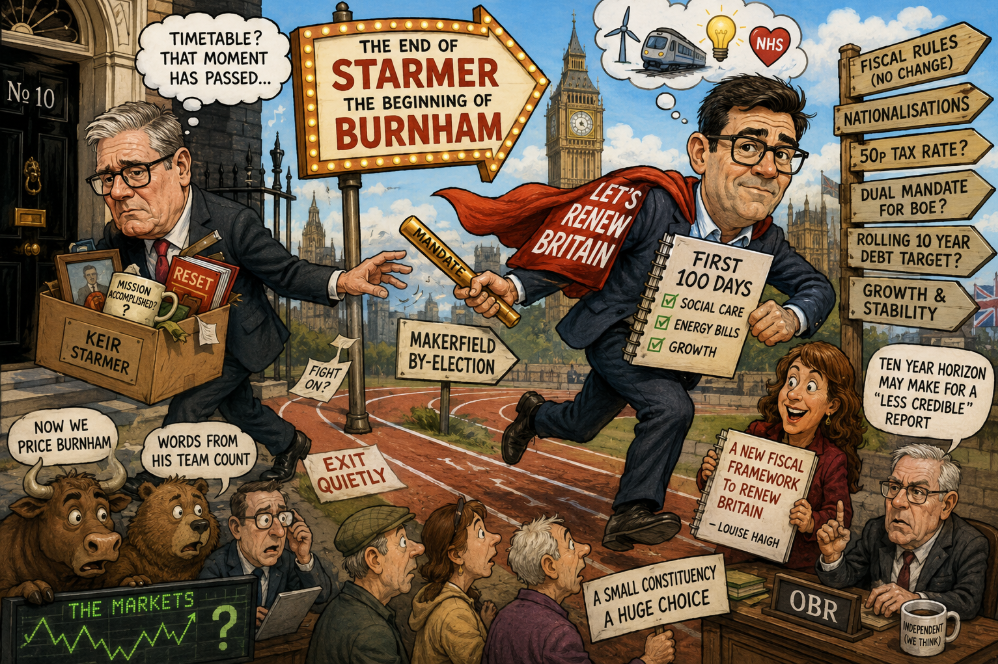
With the trade unions, one quarter of Labour MPs, a majority of Labour members and half the great offices of state calling for the prime minister to set a path to his departure, we are now at the end of the Starmer regime. He might like to think he can still set a timetable but even that moment has passed. Once the result of the Makerfield by-election is declared, it’s all over. Either Andy Burnham is the new prime minister or the Labour Party will implode. Keir Starmer’s only role is to exit quietly.
The transition of power is already underway. The markets must now price the probability of a Burnham premiership, meaning words from his team count far more than anything emanating from Downing Street (either No10 or No11).
But Burnham’s words have a constituency beyond the bond markets. He must also convince Makerfield voters, Labour MPs, the Labour Party and the country that he is the man for the job. And each one of them needs to hear a different message if he is to have any hope not only of becoming prime minister but exercising power in a functional government that goes on to win a general election.
This is going to be tricky.
Bloomberg had to encourage the Burnham team to explicitly rule out making any changes to the fiscal rules, including exemptions for defence spending, which was finally confirmed in a story published towards the bond market close yesterday. Tonight Bloomberg have followed this up with the sensible question of how he hopes to meet those rules whilst also pursuing his policy agenda that includes nationalisations and keeping energy bills under control. They rationally conclude that the man who advocated to The Telegraph last September for a return of the 50p and 10p income tax rates might look at tax rises. And that this would then mean breaking Labour’s manifesto pledges. Burnham’s spokesman would only respond by saying the Manchester Mayor “was focusing on local issues” and that he “wasn’t standing on a national manifesto at this election”. That isn’t a sustainable response for a man half way towards holding the country’s fiscal credibility in his hands. Markets don’t wait four weeks for by-elections to conclude, particularly not when a huge stagflationary shock is permeating through the global economy and forcing a repricing of government bonds.
His team is at least working on a first 100 day plan, according to Politico, where social care and rising household energy bills are the main priority. That might be important for Labour voters but once again begs the question of how it will be paid for. Soon enough there will be giddy whispers of an emergency budget.
That is unlikely given the 10 weeks of lead time required by the OBR to produce a new forecast. But will the OBR be operating under new guidelines? Some of the most in-depth policy work for a Burnham administration has come from his soft-left compatriot, the Sheffield MP Louise Haigh, who runs the Tribune group. Last week they released a detailed set of policy papers which contained Haigh’s contribution entitled “A new fiscal framework to renew Britain”. This called for a number of changes to how fiscal policy is assessed, including for debt targets to be managed on a rolling ten year, rather than five year, basis in order to ensure the full benefits of public investment in infrastructure are taken into account. At today’s Treasury Select Committee hearing, OBR chief Tom Josephs warned that a ten year horizon may make for a “less credible” economic report. This exchange, coming less than a week after Starmer insisted he would fight on, is further evidence that the world has already moved on.
In which case the markets should also be aware of Haigh’s suggestion regarding a refresh for the mandate of the Bank of England. She argues “As we approach the 30th anniversary of Gordon Brown giving the Bank operational independence to set interest rates, the time is right to re-examine the mandate and see whether better coordination and a greater focus on economic growth should also be included“. A dual mandate à la the Fed might have its merits, particularly at a moment when central banks must offset the risk of rising inflation expectations with the potential hit to economic growth. And it’s laudable to discuss radical change when the economy faces longstanding structural challenges and voters are fracturing in discomfort. It’s just unusual to do it two years into a government that won a huge landslide without gaining the mandate to enact such policies in the first place.
The UK is running a unique real time political and economic experiment. The voters of a relatively unremarkable constituency in the north west are about to choose the next prime minister who wants to run a radical reform programme whilst UK assets teeter in the face of a huge economic shock. Fortune favours the brave but not the foolhardy. We are about to find out which one Andy Burnham is.