The Road to Resignation: A study of British Prime Ministers
Our intern Emily Major considered the question: When and why do British Prime Ministers step down? An analysis of the past 50 years.
The Road to resignation
Fifty years ago, Harold Wilson closed the door of Number 10 Downing Street behind him for the final time – an abrupt departure that would come to define a broader pattern in modern British politics. Since then, Prime Ministers have seldom left office at a moment of their own choosing. More often, they have been driven out by scandal, electoral pressure, or the quiet collapse of authority within their own parties.
But what can this tell us about the current Prime Minister?
Through a hybrid methodological approach, this article analyses five decades of prime ministerial resignations to identify patterns and assess when Keir Starmer might leave office.
Methodology
This study began by the assembling of qualitative data on every British Prime Minister from Harold Wilson to Starmer, capturing the nature of their leadership. The factors that were researched were as follows: dates in office, political party, ideological placement, leader popularity at the time of resignation, economic context at the time of resignation, if there was a clear challenger/successor, and if the leader was involved in a personal scandal.
This data was then quantified, mapped onto a simple scale. An example is as follows:
| Economic context at the time of leaving |
| 5 (Very good): Strong growth (~2.5%+), low inflation, low unemployment |
| 4 (Good): Solid growth, stable inflation/unemployment |
| 3 (Neutral): Mixed signals (e.g. growth but rising inflation) |
| 2 (Bad): Weak growth or high inflation/unemployment |
| 1 (Very bad): Recession, crisis, or severe instability |
These factors were selected to build an accurate representation of the leadership, forming a basis for comparison with Starmer’s situation.
Following the aggregation of all values, the table on the left displays the cumulative score for each individual.
| PM | Total |
| Starmer | 8 |
| Sunak | 9 |
| Truss | 6 |
| Johnson | 7 |
| May | 8 |
| Cameron | 11 |
| Brown | 7 |
| Blair | 11 |
| Major | 10 |
| Thatcher | 9 |
| Callaghan | 8 |
| Wilson | 8 |
Starmer records an identical score to May, Callaghan, and Wilson, a parallel that invites closer consideration of the potential circumstances surrounding the loss of his seat.
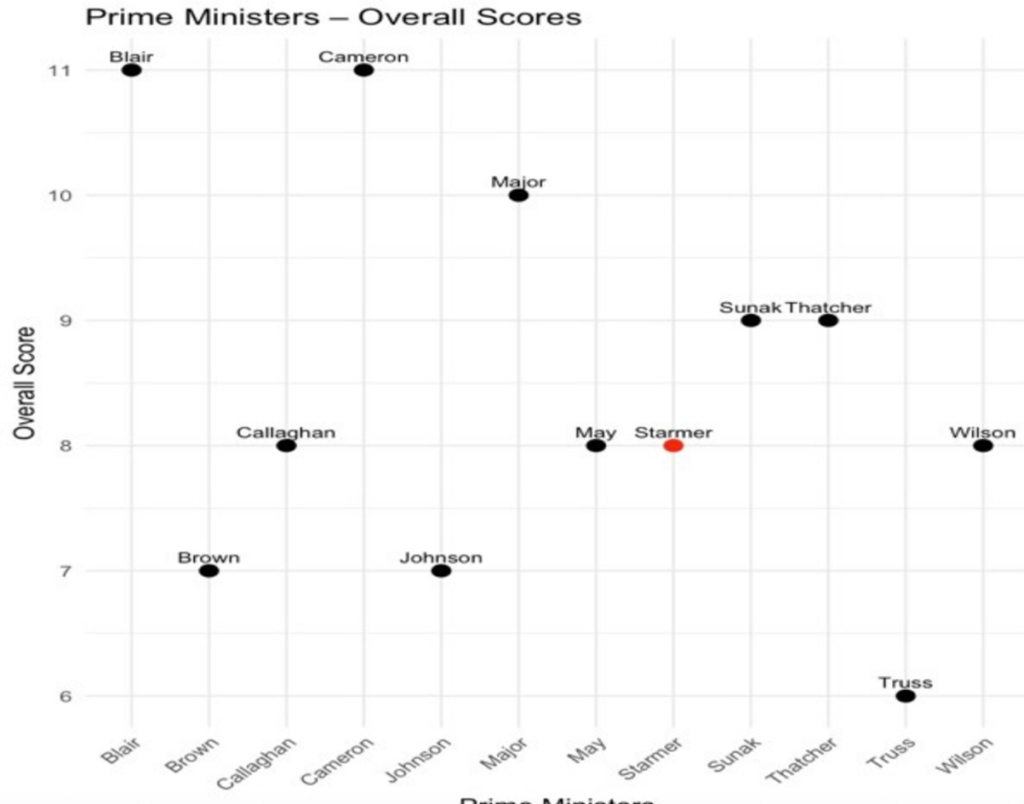
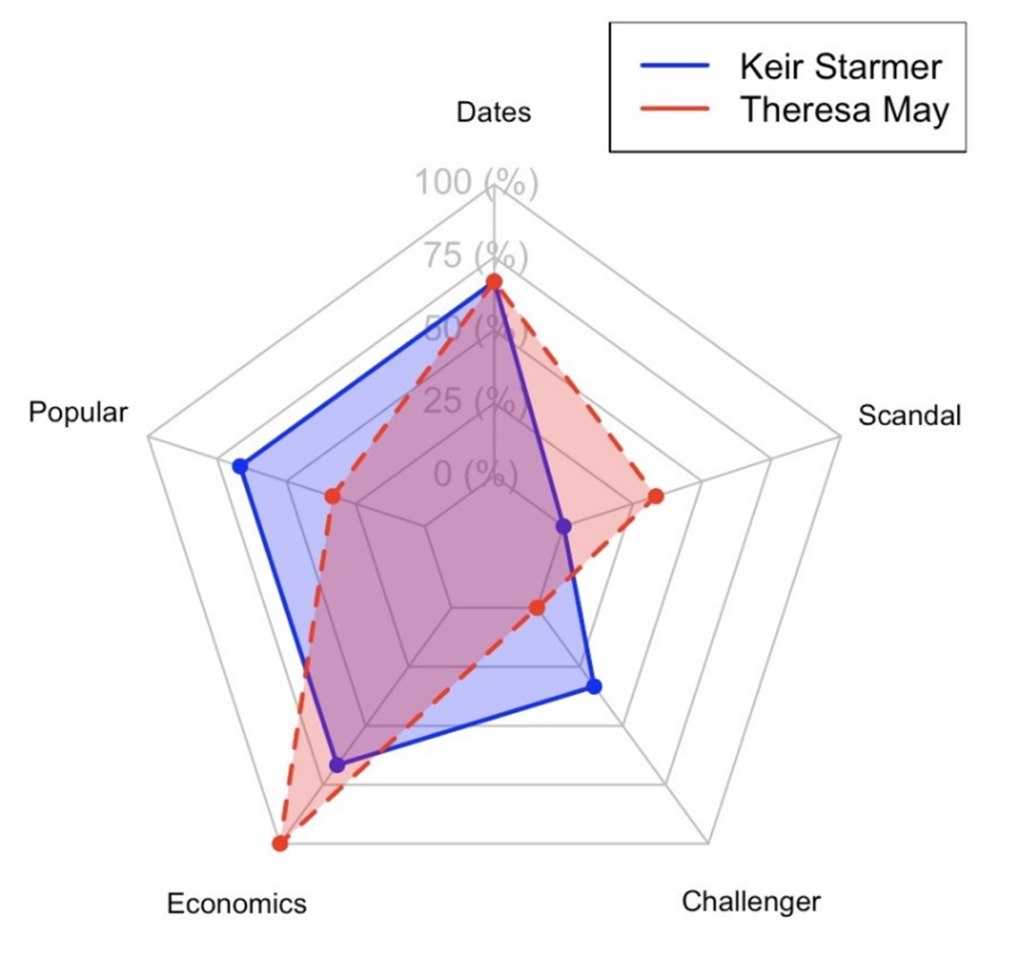
Before outlining a hypothesis, it is reasonable to treat Wilson’s case as an anomaly rather than a meaningful comparison. For Starmer to follow a trajectory truly parallel to Wilson’s, several substantive conditions would need to align: a significantly longer tenure in office, higher levels of sustained popularity, a more adverse economic climate, and the presence of a clearly defined successor. Although their scores are equivalent, a closer visual and contextual analysis suggests that Wilson does not provide a compelling or relevant point of comparison and can therefore be set aside.
When will Starmer Resign?
The data suggests that Starmer will resign when he cannot sustain electoral confidence.
There are three case studies that can substantiate this.
James Callaghan
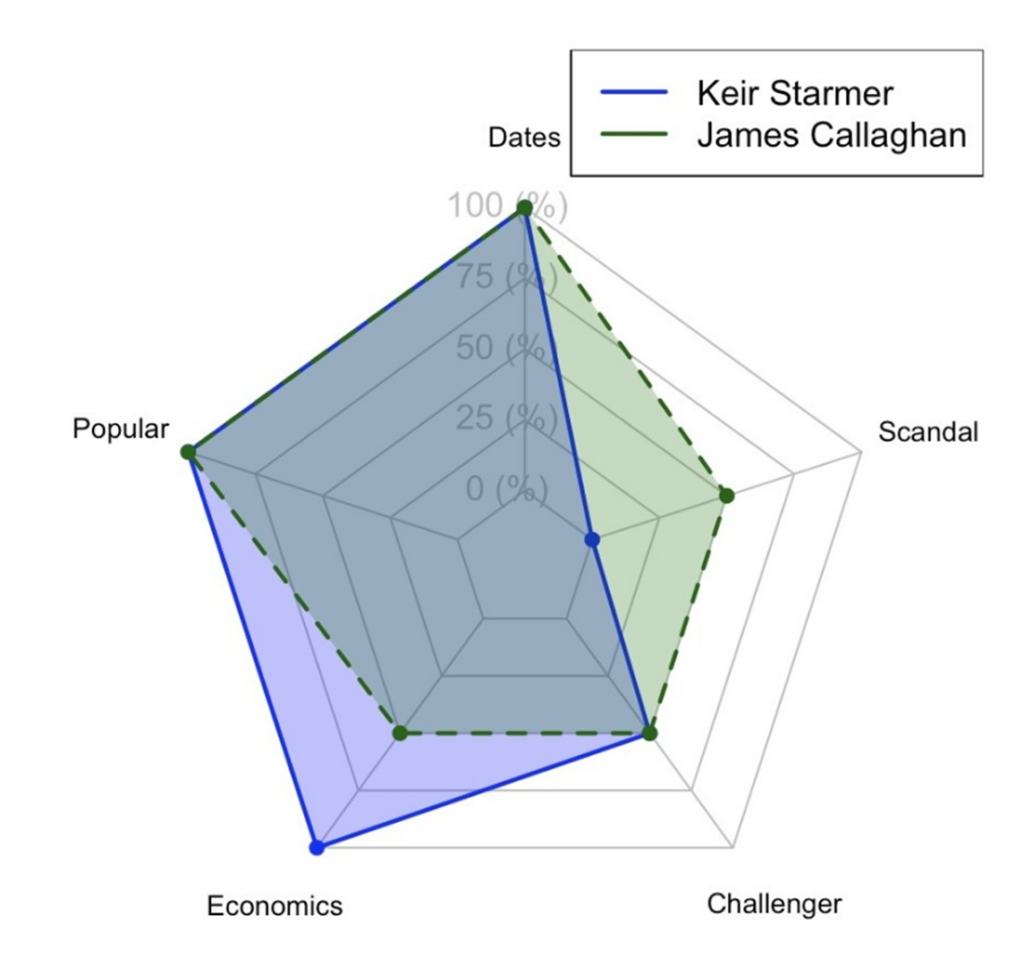
() If the Mandelson scandal does not deteriorate further into something more personal for Keir Starmer, and the economy gets worse (highly likely due to the recent escalation of conflict in the Middle East), Starmer would likely follow in the footsteps of James Callaghan.
The reason for Callaghan’s resignation…
A lost vote of no confidence, March 1979.
Theresa May
() If Starmer’s popularity declines further or a clear competitor emerges, Starmer could follow the trajectory of Theresa May.
The reason for May’s resignation…
Loss of internal party support, poor performance in local and European elections.
Rishi Sunak
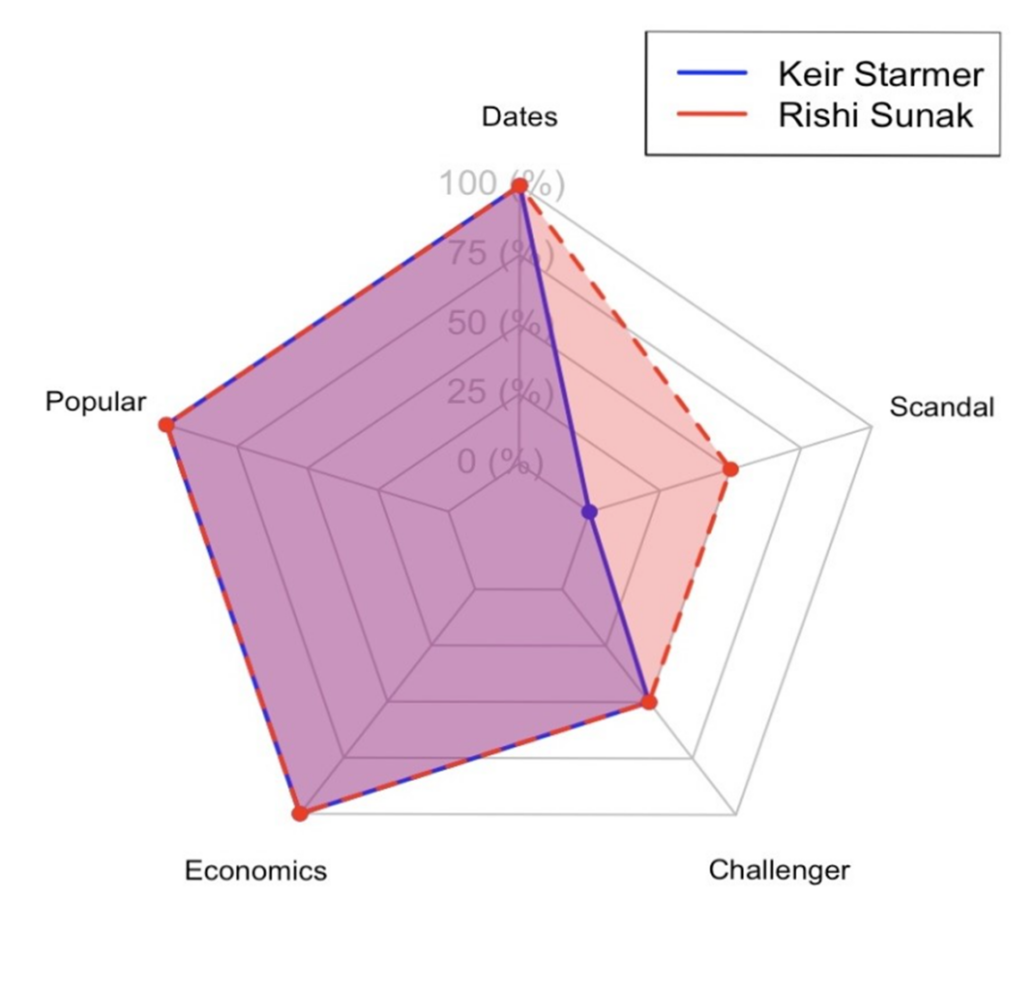
Sunak and Thatcher shared the same overall score. However, this paper will focus comparison on Sunak as the most recent former PM.
() If the Mandelson scandal is not regarded as a personal scandal for Starmer, Starmer could share the fate of Sunak.
The reason for Sunak’s resignation…
Loss of the 2024 general election
The Exit Equation
The data suggests that it will most likely be an electoral failure that prompts the resignation of Keir Starmer.
Electoral failure is both a symbol and a consequence of eroded confidence in a leader, often serving as the decisive tipping point that precipitates resignation. It represents the culmination of a breakdown across three critical dimensions: electoral confidence, intra-party authority, and broader contextual stability.
The comparative cases of Callaghan, May, and Sunak do not merely offer historical analogies; they delineate distinct mechanisms through which prime ministerial authority becomes untenable.
What emerges from these frameworks is a conditional model of resignation. Should external pressures intensify, either through economic decline or scandal escalation, Starmer’s position may unravel in a manner analogous to Callaghan. Should internal cohesion fracture in tandem with waning popularity, a May-style departure becomes increasingly probable. Alternatively, in the absence of acute internal or scandal-driven crises, Starmer’s premiership may endure until subjected to the ultimate arbitral mechanism of a general election, echoing Sunak’s fate.
- By Emily Major, April 2026
Data was collected from Ipsos MORI satisfaction ratings, YouGov, Ipsos Political Monitor Archive, and Office for National Statistics