The Two Weeks That Will Be (19th April 2026)

1. Earnings
A market scarred by last year’s post-Liberation Day whiplash doesn’t need much to reactivate its “Don’t Get Caught Short” mantra. It doesn’t matter if ceasefires don’t hold, if the logistics of moving 800 stranded ships are too complex to be immediately cleared, or if inflationary pressures from shortages are already in the supply chain pipeline. What matters is that the rate of change has changed signs: an increasingly negative situation became less negative. That means running headlong back into risky assets for fear of missing out on the rally. The “platy-leptokurtic” distribution bifurcates when the VIX index moves through the 25 level – above there, all the negative risk is priced in but below it, you can forget all about it. And so the VIX and S&P500 moved into a self-reinforcing virtuous cycle that pushed equity markets into record high territory and took the so-called Fear Index back down below the level at which it printed just before Ayatollah Khamenei was assassinated.
This is an uneasy position. An untethered Iran at the negotiating table means this is just the beginning of a new phase in geopolitical relations rather than the end.
The US is already moving onto the next battle. They have signed new defence cooperation agreements with Morocco and Indonesia, key partners for any patrolling of, respectively, the Strait of Gibraltar and Malacca. With more than 20% of global trade going through the former and 40% through the latter, both are crucial pieces on the geopolitical chess board.
But the Strait of Hormuz dominoes have already fallen, with the knock on supply shortages already taking shape. We will find out some of the impact as we enter the earnings season:
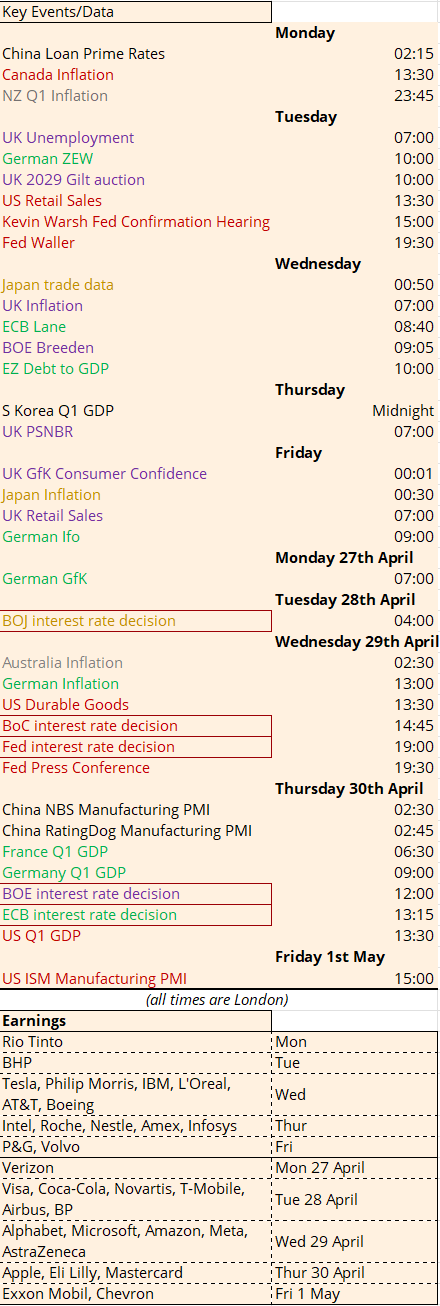
- For an update on the consumer, and in particular the different geographical impact between those in Asia, Europe and America, we get Amex on Thursday, P&G on Friday and Coca-Cola and Visa on Tuesday 28 April.
- The oil companies themselves can explain the impact on their supply chains with BP on Tuesday 28 April, and Exxon Mobil and Chevron on Friday 1 May.
- And of utmost importance due to their proportionate size in the market index, along with their voluminous energy requirements, we get MAG7 earnings from Alphabet, Microsoft, Amazon and Meta on Wednesday 29 April followed by Apple on Thursday 30 April.
2. Central Banks
Central Banks will want to keep their heads down whilst the economic shock of events in the Middle East play out. As Bank of Japan Governor Ueda said at the IMF/World Bank meetings, it is more difficult to use monetary policy to rein in inflation from a supply shock rather than one from increased aggregate demand. Whilst he left open the possibility of a move at the next BOJ meeting, noting real rates remain low and “the fact Japan’s financial environment is accommodative”, we think they will leave rates unchanged in a hawkish hold on Tuesday 28th April.
Ditto for the Bank of England and the ECB on Thursday 30th April. As the Estonian Central Bank Governor Muller pointed out, they are unlikely to have enough data by then. And it’s not as if the shock is necessarily over yet: “something could go terribly wrong with the peace negotiations. The duration of the war is the biggest unknown that will drive energy prices and will have broader implications for growth and inflation“.
We are in a world where the politics very much trumps, pun intended, the economics. The Fed on Wednesday 29th April will also remain on hold. This will be Jerome Powell’s last meeting as Chair (assuming his replacement has been confirmed by the end of Powell’s term on 15th May) so his comments will be less relevant than what we hear from Kevin Warsh at his confirmation hearing on Tuesday. With a market that anticipates Warsh will be dovish come what may, there is the potential for a hawkish surprise in his responses to Senate Banking Committee questions. Having already gone through one nomination process to become a Fed Governor along with his role in George W Bush’s National Economic Council and countless other political positions, Warsh knows how to play the political game.
3. Growth
With most data already out of date due to the shock permeating from Hormuz, we will get a sliver of information in the shape of Q1 GDP data. It kicks off with one of the most impacted nations, South Korea, on Thursday, followed by France, Germany and the US on Thursday 30th April.
4. The UK
If only the UK government could simply worry about growth. The toxic combination of higher inflation, higher energy prices and higher debt conspired to see the IMF cut 2026 growth forecasts for the UK by more than any other G7 country. The increasing post-Truss vulnerability of the UK to shocks is picked up by this chart from JP Morgan of fiscal stress, which they measure as the proportion of trading days where a country’s equity, fixed income and currency markets simultaneously fall (h/t to Robert Colvile in The Sunday Times):

The increasing gap with the US has not stabilised by as much as Rachel Reeves would claim. The Chancellor gives a keynote speech on Tuesday at the Good Growth Foundation’s “National Growth Debate” conference. There will also be a 2029 Gilt auction the same day, hot on the heels of the largest single issuance that was completed by syndication for almost £15bn at the highest yield since 2008. Those yields are unlikely to fall by much whilst inflation accelerates. The latest inflation print is released on Wednesday. That is followed on Thursday by the PSNBR, the real litmus test of deterioriating debt/deficit dynamics.
And we haven’t even mentioned Peter Mandelson.